 blog
blog
Choosing Promotional Products for Small Budgets
Table of Contents
- Why Promotional Products Still Work When Your Marketing Budget Is Tight
- How to Set a Realistic Marketing Budget for Giveaways
- The Best Promotional Items for Brand Recall
- Custom Apparel for Small Business Branding: A Practical Guide
- How to Measure Promotional Product ROI
- Mistakes Small Businesses Make With Promotional Products
- Conclusion
- Frequently Asked Questions
Last Updated: October 2, 2026
Why Promotional Products Still Work When Your Marketing Budget Is Tight
Promotional products remain one of the most cost-effective ways to build brand awareness, especially when cash is tight.
The math is simple. A single well-chosen item can deliver thousands of impressions over its lifetime.
But most small businesses get this wrong. They buy the cheapest bulk item available, hand it out once, and never see a return. The fix starts with a clear budget and a clear goal.
- Brand recall beats one-time novelty
- Utility beats flashiness
- Right audience beats sheer volume
How to Set a Realistic Marketing Budget for Giveaways
Start with a percentage, not a guess. Many small businesses set aside a small slice of their overall marketing budget for giveaways, often in the low single digits.
Work backward from your goal. If you want 200 qualified leads at a trade show, and you expect one in ten visitors to convert, you need roughly 2,000 items.
Here is a simple way to frame it:
| Goal | What to Prioritize | Budget Approach |
|---|---|---|
| Brand awareness | High-visibility items | Spend more per unit |
| Lead generation | Useful, low-cost items | Spend less per unit |
| Customer retention | Quality, durable items | Spend more per unit |
Set the number before you shop.
Calculate Your True Per-Unit Ceiling, Not the Sticker Price
The number on the product page is not your cost. Your real per-unit ceiling has to absorb four line items that most small buyers forget until the invoice arrives:
- Unit price at your actual quantity tier
- One-time setup or screen charge per imprint color and location
- Shipping and freight to your address or event venue
- Rush fees if your timeline is short
A common pattern is a setup charge that runs into the tens of dollars per color, per location, and freight that adds a meaningful percentage on top of a light, low-cost item. On a small run, those fixed costs can double your effective cost per piece. Divide your total landed cost by the number of usable items, not the number you ordered, to get the figure that actually matters.
How Minimum Order Quantities Reshape the Math
Most decorated suppliers publish a minimum order quantity (MOQ), often 12, 24, 50, or 100 units depending on the item and decoration method. MOQs exist because setup and production runs have fixed costs. That cuts both ways for a small budget:
- Ordering at the MOQ usually gives you the worst per-unit price.
- Ordering well above the MOQ drops the per-unit price but ties up more cash up front.
- Splitting one order across multiple items can trigger multiple setup charges and erase the savings.
A practical move is to pick one hero item, order at a quantity tier that lowers the unit price, and skip the temptation to spread a small budget across five different giveaways. One item at a good tier usually beats five items at the worst tier.
Build a One-Page Budget Worksheet
Before you request a single quote, write down these five numbers:
- Total dollars available for the campaign
- Target number of recipients
- Maximum landed cost per item (total dollars ÷ recipients)
- Allowance for setup, freight, and any rush fee
- A 10-15% buffer for surprises
That buffer is not padding. Color mismatches, a short shipment, or a last-minute quantity bump are common, and a small reserve keeps the campaign from stalling.
The Best Promotional Items for Brand Recall
The best promotional items for brand recall are ones people use every day and keep for months. Utility drives memory.
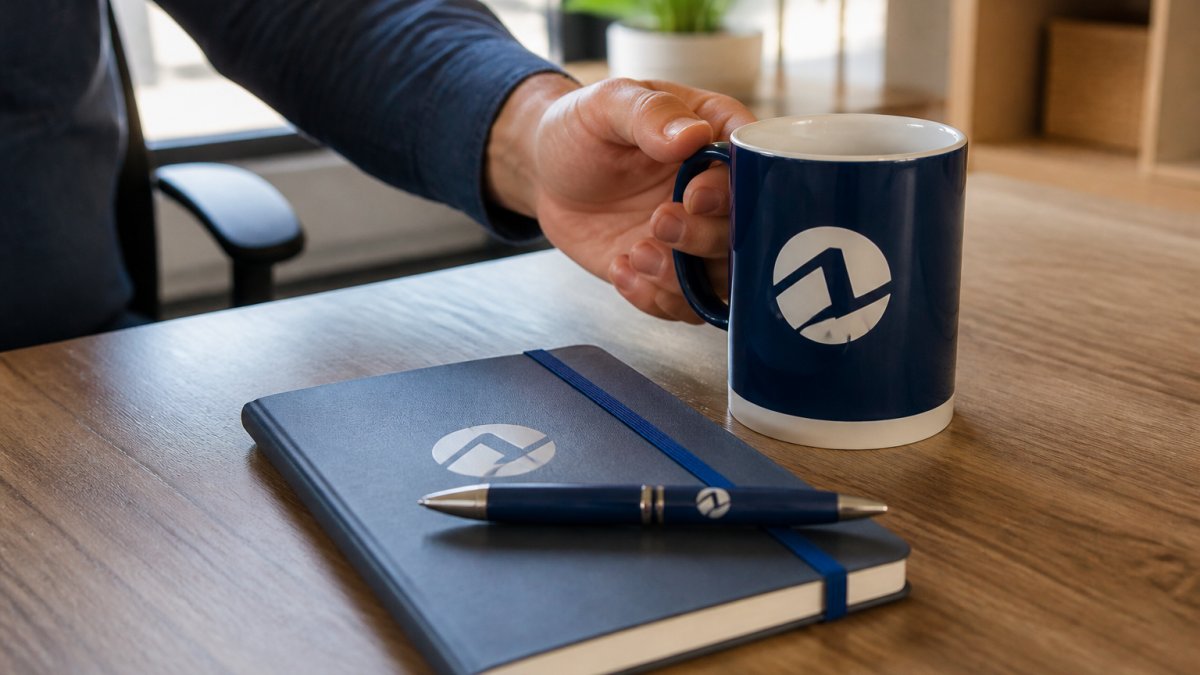
Top performers tend to share three traits: daily use, visible placement, and durability. Think drinkware, notebooks, tote bags, and quality pens.
Eco-friendly options are gaining ground too. Sustainable materials like recycled cotton or bamboo can boost perceived value and align with what many buyers now expect.
- Drinkware: seen daily, high recall
- Notebooks: used in meetings, long lifespan
- Tote bags: carried in public, free advertising
- Quality pens: low cost, high turnover
Custom Apparel for Small Business Branding: A Practical Guide
Custom apparel for small business branding works best when it targets the people who represent you in public.
Cheap apparel fades, peels, and shrinks. That wastes money and hurts your image.
Match the garment to the setting. A construction crew needs rugged workwear. A bank branch needs polished, professional pieces.
- Choose fabrics that survive repeated washing
- Confirm logo placement before production
- Order a sample before a full run
That last point matters. A sample lets you check color, size, and placement before you commit.
How to Measure Promotional Product ROI
Measuring promotional product ROI means tracking what each item costs against the value it brings back.
To measure it well, you need two things: a clear cost and a clear outcome. Cost includes the item, customization, and shipping. Outcome can be leads, sales, or repeat business.
Here is a practical way to track it:
- Assign a unique code or landing page to each campaign
- Ask new customers how they heard about you
- Compare cost per lead across item types
- Review results after 90 days, not 9
Cost-per-impression is a useful secondary metric. It estimates how many times an item is seen over its life.
The Hidden Costs That Kill Small-Budget ROI
Most ROI write-ups stop at the product price. That is the smallest number in the equation. The costs that actually decide whether a small campaign pays off are the ones that show up after the order:
- Inbound freight from the supplier to your location
- Repackaging or kitting if you bundle items into gift sets
- Outbound shipping to remote employees, customers, or event attendees
- Storage if you order in bulk and hand items out over months
- Labor to assemble, label, and distribute
A common pattern is a giveaway where the distribution cost per item rivals or exceeds the product cost per item, especially when items ship individually to scattered recipients. If you are mailing a low-cost item one at a time, the postage can quietly become the largest line on the budget. Before you commit, get a shipping estimate for the full distribution plan, not just the inbound freight, and fold it into your cost-per-lead math.
Why Perceived Value Beats Actual Price
Two items can cost you the same dollar amount and produce opposite results, because recipients judge value by feel, not by your invoice.
The mechanics are simple. Perceived value rises with:
- Weight and heft, a heavier item feels more substantial
- Material quality, metal, thick fabric, and sturdy construction signal durability
- Usefulness in context, an item that solves a real, recurring problem feels valuable
- Finish and detail, clean edges, a crisp imprint, and good packaging raise the impression
This is why a modestly priced item that feels solid and useful can outperform a slightly cheaper item that feels disposable. When you are choosing on a small budget, spend your money on the traits that signal quality, not on the lowest possible unit price.
Tie ROI Back to the Campaign, Not the Item
A promotional item rarely converts on its own. It converts because it is attached to something: a landing page, an event, a follow-up email, or a referral ask. When you measure ROI, measure the campaign, not the object.
- Give every campaign its own code, URL, or QR destination so you can attribute results
- Compare cost per lead across campaigns, not just across items
- Track repeat business from recipients, not only first-time conversions
- Review at 90 days and again at 12 months for durable items
Mistakes Small Businesses Make With Promotional Products
The biggest mistake is buying on price alone. Cheap items break, fade, or get thrown away, which wastes the whole budget.
Another trap: ordering too few. Bulk ordering lowers your per-unit cost, so tiny runs often cost more per piece.
Watch for these pitfalls:
- Ignoring minimum order quantities and blowing the budget
- Skipping logo placement checks before print
- Choosing disposable items that hurt your brand image
- Failing to tie giveaways to a broader marketing strategy
A branded item should support a campaign, not stand alone. Pair it with a landing page, an event, or a follow-up email.
Conclusion
Stretching a small budget on promotional products comes down to choosing items people actually keep and use.
Logo Concepts & Printing has spent over 25 years helping businesses and organizations build their brand through high-quality custom apparel, printing, and marketing solutions.
Contact us today to get a quote and start building your brand with items your customers will actually keep.
Frequently Asked Questions
What are the most cost-effective promotional products for small businesses?
Items people use daily deliver the most impressions per dollar. Custom pens, branded notebooks, and logo'd drinkware stay in sight for months, so each impression costs very little. Ordering larger quantities lowers the unit price, and choosing one useful item over several cheap novelties keeps the budget focused. Ask your vendor for a quote on 250, 500, and 1,000 units to see how the per-piece cost drops.
How do I choose promotional products that customers will actually keep?
Focus on utility and perceived value. Items that solve a small problem, like a sturdy tote bag, a phone stand, or a quality water bottle, get kept and used. Avoid anything that feels disposable; if it breaks or looks cheap, it hurts your brand. Match the item to your audience's daily routine, and make sure your logo is placed where it is seen without being intrusive.
How do promotional products contribute to brand recall?
Brand recall grows through repeated, positive exposure. When someone uses a branded item daily, your logo becomes familiar. The key is choosing products with high perceived value and long lifespans, like apparel or drinkware, so the exposure lasts. Studies consistently show that useful promotional items generate more impressions per dollar than many traditional ads, especially when the item is kept and used.
How can I measure the ROI of promotional products?
Start by setting a clear goal: leads, event traffic, or repeat orders. Use unique URLs, QR codes, or promo codes on the items to track responses. Calculate cost-per-impression by estimating how often the item is used and dividing that by the total cost. Then compare the value of leads or sales generated against your spend. Even a rough estimate helps you decide what to repeat next year.