 blog
blog
Custom Apparel for Small Event Budgets: Smart Strategies
Table of Contents
- Why Custom Apparel Matters for Small Events
- Understanding Low Minimum Custom Apparel Options
- Bulk Screen Printing for Events: Cost Breakdown
- Cost-Effective Event Branding Ideas That Work
- Hidden Costs to Watch and How to Avoid Them
- Quality That Lasts: Fabric and Durability on a Budget
- The Digital Mockup Workflow: Approval Before Print
- Turnaround Times and Rush Order Realities
- Frequently Asked Questions
Last Updated: September 23, 2026
Why Custom Apparel Matters for Small Events
The right custom apparel builds team unity, creates lasting impressions, and turns attendees into walking advertisements for your brand, without requiring a massive budget.
Custom apparel for small event budgets is tangible, memorable, and extends your marketing message long after the event ends, unlike digital ads that disappear.
The challenge is finding options that don't break the bank while maintaining quality standards. At Logo Concepts & Printing, we've spent over 25 years helping businesses navigate this problem.
Understanding Low Minimum Custom Apparel Options
What "low minimum" actually means:
Most vendors set minimums between 12 and 50 units per design. Print-on-demand services offer no minimum but higher per-unit costs.
Key minimum quantity considerations:
- Under 25 units: Print-on-demand or specialty vendors; higher per-piece cost
- 25-50 units: Sweet spot for small teams; better pricing without bulk commitment
- 50+ units: Significant cost savings per item; requires storage and distribution planning
- 100+ units: Best unit pricing; bulk pricing discounts kick in substantially
The math is simple: lower minimums mean flexibility. Higher minimums mean better per-item pricing. Your event size determines which makes sense.
Avoid ordering excess units to hit lower price points. Calculate your actual need, add 10-15% for extras and giveaways, and stop there.
Bulk Screen Printing for Events: Cost Breakdown
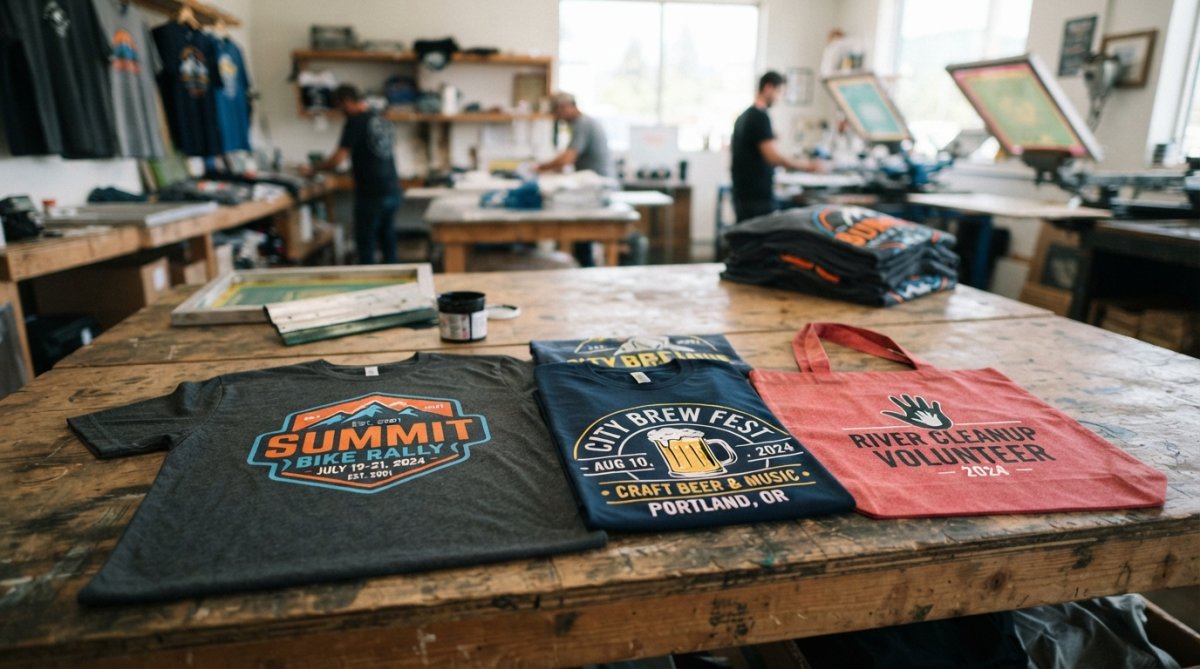
Screen printing remains the most cost-effective method for medium-to-large event orders. Understanding the pricing structure helps you budget accurately and avoid surprises.
How screen printing pricing works:
Screen printing charges often include setup fees, ink costs, and per-garment labor.
Common pricing components:
- Setup/color separation: One-time charge per design color
- Screen creation: Usually included in setup or charged separately
- Per-piece printing: Decreases with volume
- Garment cost: Varies by fabric quality and style
- Rush fees: Add 25-50% for expedited turnaround
A small chest logo costs less than a full-back design. Fewer colors mean lower setup costs, two-color designs cost significantly less than four-color designs.
Combine orders for volume discounts. Printing 50 navy and 50 gray shirts with the same design qualifies as a 100-unit order, applying bulk pricing to the entire batch.
Cost-Effective Event Branding Ideas That Work
Smart design choices cut costs without sacrificing impact. Focus on what matters most to your audience and eliminate unnecessary complexity.
Choosing the Right Garment Style
Garment selection strategy:
Standard cotton t-shirts offer the best value. Heavier-weight cotton (6.0 oz or more) feels premium and lasts longer through multiple washes.
Consider your audience's actual use. Construction crews might prefer work-appropriate apparel; volunteers might appreciate moisture-wicking options; corporate teams often prefer polos.
Garment choices that save money:
- Basic t-shirts: Lowest cost; highest versatility
- Cotton blends: Mid-range cost; better durability than 100% cotton
- Unisex cuts: Cheaper than fitted or gender-specific styles
- Standard colors: Cheaper than specialty or dyed fabrics
- No pocket: Saves on garment cost and print placement complexity
Design Placement and Color Strategy
Design placement best practices:
Chest placement costs less than back placement. Small logos (3-4 inches) cost less than large designs.
Full-back designs require larger screens and more ink, increasing costs significantly. A centered chest logo delivers strong branding at half the cost.
Color count is critical. Each additional color adds a setup fee and increases per-garment labor time.
Strategic color choices:
- Single color: Lowest cost; timeless look
- Two colors: Minimal additional cost; adds visual interest
- Three+ colors: Setup costs compound; consider print-on-demand instead
- Specialty inks: Metallics or specialty colors add premium cost
A two-color design on a dark garment can look as professional as a four-color design. Choose colors with strong contrast, black ink on white reads clearly; black ink on navy disappears.
Hidden Costs to Watch and How to Avoid Them
Most budget surprises come from overlooked fees stacked on top of per-garment pricing. Event planners often underestimate total cost by 15-30%.
The complete hidden cost breakdown:
Setup and color separation fees: Each color triggers a separate charge ($25-$75 per color). A three-color design costs $75-$225 before printing begins. Ask upfront whether setup is per-color or flat-rate.
Art file preparation and vectorization: If your logo isn't print-ready (JPG or PNG), vectorization costs $50-$150. This fee is waived if you provide a native vector file (.ai or .eps).
Proof and revision charges: Most vendors include one free proof. Additional revisions cost $15-$50 each. Make all changes at once to avoid multiple revision cycles.
Shipping costs: A 50-unit order weighs 25-30 pounds. Ground shipping ranges $35-$100 depending on distance. Expedited shipping adds $75-$150. Always request shipping quotes before finalizing your order.
Rush order premiums: Standard turnaround (7-14 days) has no premium. Expedited (3-5 days) adds 25-50%. Next-day production adds 75-100%. Plan three weeks ahead to avoid rush fees.
Minimum order quantity (MOQ) overages: Don't order excess units to hit lower pricing. Calculate your actual need, add 10-15% for extras, and stop there.
Specialty ink and finish charges: Metallic or glow-in-the-dark inks cost $0.50-$2.00 more per garment. Standard ink is most budget-friendly.
Design complexity fees: Photorealistic images or gradients require advanced color separation ($25-$100 extra). Stick to bold, simple designs for budget orders.
How to avoid surprises, the complete checklist:
Request a written quote listing: per-garment cost, setup fees, art preparation, proof policy, revision costs, shipping, rush fees, specialty charges, payment terms, and cancellation policies.
Ask: "Is there anything else I should budget for?" Confirm your logo file format and vectorization costs upfront. Request one digital proof and approve in writing. Get shipping quotes early. Plan your timeline backwards from your event date.
Always get a complete written quote before ordering.
Quality That Lasts: Fabric and Durability on a Budget
Budget apparel doesn't mean low-quality apparel. The real ROI comes from designing apparel people actually want to wear long after the event ends.
Fabric choices that balance cost and wearability:
Heavier cotton (6.0 oz or more) resists pilling, fading, and wear. The cost difference is often minimal, but durability improves substantially.
Cotton-polyester blends (80/20 or 90/10) resist shrinking and maintain color better than 100% cotton. For repeated wear, a blend is often worth the extra investment.
Pre-shrunk garments prevent fit issues after the first wash, ensuring people keep wearing the shirt.
Durable fabric choices ranked by value:
- 6.0+ oz pre-shrunk cotton: Best durability for budget; classic feel; lasts 50+ washes
- Cotton-poly blend (80/20), pre-shrunk: Fade-resistant; less shrinking; maintains fit longer
- Ring-spun cotton: Softer feel; better color retention; slightly higher cost
- Lightweight cotton (under 5.5 oz): Cheapest option; feels thin; wears out faster
Screen printing bonds ink directly to fabric and is known for its durability. Heat transfer sits on top and may fade over time. For repeated wear, screen printing is often a better investment.
Ask your vendor about ink standards. Professional vendors use plastisol inks that are known for their durability. Cheaper inks may fade faster; the cost difference is often minimal.
Designing for post-event wear, the strategic angle:
The biggest mistake is designing apparel that screams "corporate giveaway." A shirt with your logo, event name, and date looks dated the moment the event ends.
Design strategies that increase post-event wear:
Keep branding subtle. A small chest logo (2-3 inches) is far more wearable than large back prints. People wear subtle branded apparel casually; they avoid walking billboards.
Avoid event-specific text. A shirt that says "Annual Conference 2026" becomes unwearable in 2027.
Print durability and fabric quality checklist:
- Confirm plastisol inks and 6.0+ oz pre-shrunk fabric
- Choose screen printing over heat transfer
- Request a sample before ordering 100+ units
- Design with post-event wear in mind, subtle branding, no event dates, versatile colors
- Prioritize fit and comfort
The Digital Mockup Workflow: Approval Before Print
Mockup workflow steps:
Request a digital mockup showing your exact design on your chosen garment color and style. This should be free and happen before you approve production. Review it carefully for placement, sizing, and color accuracy.
Approval process best practices:
- Request mockup before paying in full
- Review on multiple devices if possible
- Check placement from multiple angles
- Ask for color samples if critical
- Approve in writing (email confirmation counts)
- Keep approval documentation for your records
Turnaround Times and Rush Order Realities
Standard turnaround ranges from 7-14 business days for most screen printing orders. Rush orders cost more but sometimes fit the budget if planned carefully.
Turnaround timeline breakdown:
Rush order costs and timelines:
- Standard (7-14 days): Full pricing; no rush fee
- Expedited (3-5 days): Add 25-50% to total cost
- Next-day production: Add 75-100% to total cost; may not be available
Frequently Asked Questions
How can I save money on custom apparel for small events?
Start by reducing color counts in your design, which lowers setup fees significantly. Choose cost-effective garment styles like basic cotton t-shirts over premium options. Negotiate bulk pricing even at modest quantities, and plan ahead to avoid rush order premiums. Design placement also affects cost, a single chest print costs less than full-back or multi-location designs. Work with a provider offering low minimum custom apparel orders so you're not forced to buy more than needed.
What is the most cost-effective printing method for small batches?
Screen printing typically offers the best unit cost for small batches once you factor in setup fees, especially if you keep color counts low. Heat transfer works well for very small quantities without setup charges. Print-on-demand options eliminate minimum order quantities entirely but cost more per item. For bulk screen printing for events, negotiate based on your final quantity, even modest orders of 25-50 pieces can qualify for better pricing than single-item production.
Are there hidden costs when ordering custom event apparel?
Yes. Setup fees, art charges for vector artwork preparation, rush delivery, and expedited production all add up fast. Some providers charge for design mockups or revisions. Shipping costs increase with weight and distance. Ink coverage levels affect price, large full-back prints cost more than small logos. Ask your provider for a complete cost breakdown upfront, including all fees, so you avoid surprises when the final quote arrives.
How do I balance quality and budget constraints?
Choose durable fabrics like mid-weight cotton or cotton-blend blends that resist fading without premium pricing. Verify garment quality through samples before committing to large orders. Limit design complexity to reduce color counts and ink coverage, which saves money without sacrificing appearance. Focus your budget on fit and fabric weight rather than expensive embroidery or specialty finishes. Request examples from your provider to confirm print quality actually lasts through multiple washes.