 listicle
Custom Workwear for Automotive Shops: 2026 Guide
Table of Contents
- Top Custom Workwear Brands for Automotive Shops in 2026
- Durable Mechanic Shirts with Logo: Fabric and Feature Checklist
- Custom Embroidery vs Screen Printing for Work Shirts
- Automotive Shop Uniform Policy Best Practices
- Pricing, Bulk Ordering, and Turnaround Times
- Caring for Custom Workwear So It Lasts
- Frequently Asked Questions
Last Updated: September 11, 2026
Top Custom Workwear Brands for Automotive Shops in 2026
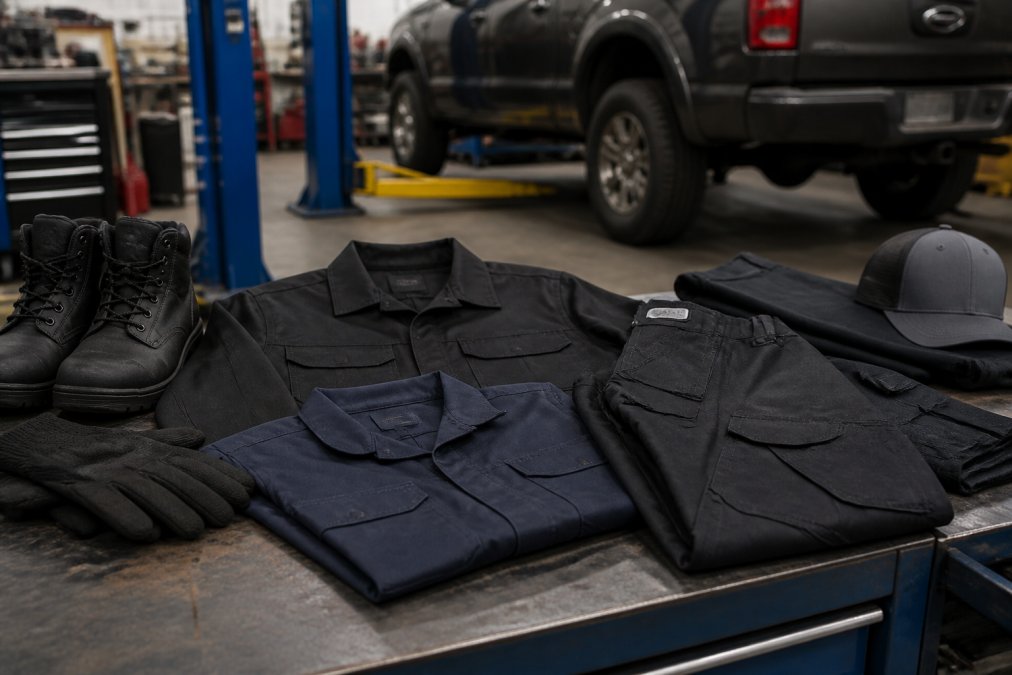
Custom workwear for automotive shops is branded apparel built for technicians, service writers, and dealership staff to resist oil, grease, and daily wear while carrying your shop's logo. This guide from Logo Concepts & Printing covers the fabrics, decoration methods, and pricing that separate workwear lasting three years from workwear that fades in three months.
The cheapest quote per shirt almost never produces the lowest cost per year. A shirt that pills, fades, or loses embroidery after twenty industrial washes gets replaced twice as often, and replacement costs dwarf the upfront savings (peer-reviewed research).
What to Look for in a Workwear Partner
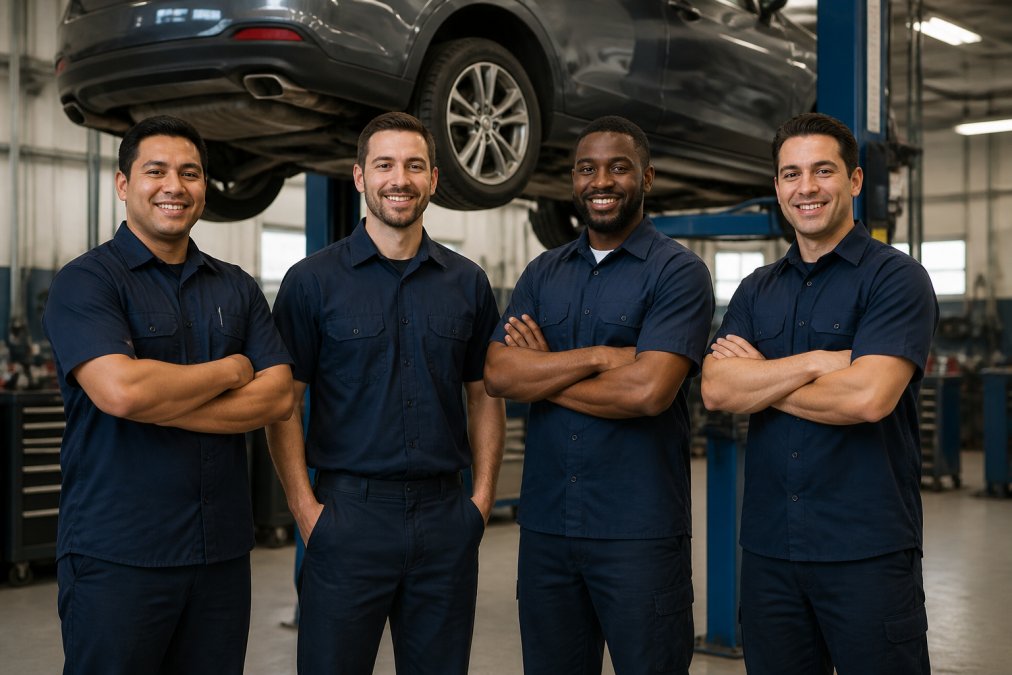
The right workwear partner offers three things: oil-resistant fabrics, in-house decoration, and turnaround times measured in days rather than months.
Logo Concepts & Printing produces a full mockup before production begins. Approving a digital logo file without seeing it stitched on the garment is a common mistake, embroidery renders differently than a flat PNG, and thread color shifts under shop lighting. Our in-house design team proofs the exact placement, thread color, and size so you approve what you'll actually receive.
Beyond decoration, evaluate these factors:
- Fabric weight and weave: Heavier cotton blends resist abrasion; open weaves breathe better in summer heat
- Reinforced stress points: Bar-tacked pockets and double-stitched seams survive daily pocket use
- Button type: No-scratch buttons protect vehicle finishes when technicians lean over fenders
- Size range: A partner carrying only standard sizes will leave half your team in ill-fitting shirts
Durable Mechanic Shirts with Logo: Fabric and Feature Checklist
Durable mechanic shirts with logo applications should combine stain-release chemistry, moisture management, and reinforced construction, surviving motor oil, brake fluid, and hot metal while looking presentable at the service counter.
Oil-Resistant and Stain-Release Fabrics
Stain-release finishes lower the fabric's surface tension so liquids bead and roll instead of soaking in, the difference between a grease splatter becoming a permanent mark or wiping away with a shop rag.
Look for stain-release or soil-release technology. The finish degrades over repeated industrial laundering, so the longest-lasting shirts combine it with a tight weave that keeps oil from penetrating the fiber (PubMed). Dickies Industrial Workwear built its reputation on exactly this combination, making it a default choice for shops prioritizing durability over trendy styling.
Moisture-Wicking and Breathability in Garage Heat
A service bay in July runs hotter than the outdoor temperature because engines, lifts, and welding equipment radiate heat. Moisture-wicking fabrics move sweat to the surface where it evaporates; without that, cotton saturates and stays wet against the body for hours.
Wicking and breathability aren't synonyms: wicking handles moisture transport, breathability governs airflow. A shirt can wick well and still feel stifling if the weave is too tight. For summer, prioritize lighter-weight blends with visible airflow; reserve heavier cotton twills for winter.
Custom Embroidery vs Screen Printing for Work Shirts
Custom embroidery and screen printing serve different purposes in automotive workwear; the right choice depends on garment type, logo complexity, and how long the decoration must last.
Embroidery stitches thread directly into the fabric. It handles curved surfaces, small text, and detailed logos, and won't crack or peel because there's no applied layer to fail. The tradeoff is cost at low quantities and slight added weight. For polos, button-downs, jackets, and hats, embroidery is almost always better.
Screen printing applies ink through a mesh stencil, cost-effective at volume, good for large graphics and bright colors, with a smooth finish. On stretch garments the ink can crack over time, and complex gradients require multiple screens that drive up setup cost.
| Factor | Embroidery | Screen Printing |
|---|---|---|
| Best for | Polos, jackets, hats, small logos | T-shirts, large graphics, volume runs |
| Durability | Outlasts the garment | Can crack on stretch fabrics |
| Setup cost | Digitizing fee per logo | Screen fee per color |
| Color range | Limited by thread stock | Nearly unlimited |
| Feel | Slightly raised, textured | Smooth, flat |
For a shop ordering both shop shirts and coveralls, a common approach is embroidery on the structured garments and screen printing on the high-volume tees.
Automotive Shop Uniform Policy Best Practices
An automotive shop uniform policy works when it's short, specific, and built with technician input. Policies that run three pages get ignored; one-page policies get followed. Below is a working structure you can adapt, plus clause language that prevents the arguments most shops run into.
Why a Written Policy Pays for Itself
A branded uniform protects technicians from oil, grease, and hot metal while telling every customer this is a professional operation. Shops that formalize their program see fewer appearance disputes, faster onboarding, and a more consistent customer-facing look.
The One-Page Policy Template
Copy this structure, fill in your shop's specifics, and have two or three senior technicians review it before rollout.
1. Purpose and Scope State that the policy keeps technicians safe, presents a professional image, and standardizes what the shop provides. Name who it covers, technicians, service writers, parts staff, shuttle drivers, and note that branded apparel remains shop property.
2. Allocation Spell out what each role receives at hire and on what schedule:
- Technicians: 5 shirts and 2 pairs of pants at hire, then 3 replacement shirts annually
- Service writers / front counter: 5 button-down or polo shirts at hire, then 3 annually
- Parts and shuttle: 4 shirts at hire, then 2 annually
- Outerwear (jackets, coveralls): issued as needed, returned at separation
Adjust counts to your climate and wash cycle, but put a number in writing. "As needed" is not an allocation.
3. Responsibility for Laundering Decide whether the shop launders in-house, technicians launder at home, or you use a rental service:
- Home laundering: lowest direct cost, but you rely on technicians to follow care instructions, and stain-release finishes degrade faster with hot water and fabric softener
- Shop laundry: consistent results and controlled chemistry, but requires equipment, detergent, and someone to run it
- Rental service: predictable recurring cost and professional cleaning, but you don't own the garments and you're locked into a contract term
Whichever you choose, write it down with the care rules (cold or warm water, no fabric softener, inside-out, low heat).
4. Replacement and Damage This clause causes the most friction and gets skipped most often. A workable split:
- Normal wear (fading, seam failure, embroidery loss within a reasonable period): shop replaces at no cost to the technician
- Negligence (lost garment, deliberate damage, garment used for non-work tasks): technician pays a stated replacement fee, deducted per your state's payroll rules
- Damage from a work incident (acid splash, welding burn, chemical exposure): shop replaces, and the incident is logged
Check your state's wage-deduction rules first, some require written authorization, and a few prohibit uniform deductions entirely. When in doubt, absorb the cost as a retention expense.
5. Appearance Standards Keep this short and observable: clean shirt daily, tucked or untucked (pick one), name patch on the left chest, no visible undershirt logos, closed-toe boots. Avoid subjective language like "neat and professional", it invites inconsistent enforcement.
6. Return of Property State that branded apparel is shop property and must be returned at separation, and what happens if it isn't (paycheck deduction where legal, or a note in the file). This also keeps your logo from walking out the door with a departing employee.
Common Policy Mistakes to Avoid
- No replacement clause. Without a written process, damaged uniforms become a recurring argument, and managers absorb replacement costs informally, blowing the apparel budget.
- Allocation by "as needed." Vague allocations get interpreted generously by some and stingily by others, eroding trust.
- Ignoring state deduction rules. A deduction clause that violates your state's wage law can cost more than the garment ever would.
- No technician input. A policy written in an office and handed down gets followed grudgingly at best.
- No review date. Set an annual review so the policy keeps pace with headcount, role changes, and new garment options.
Rolling It Out
Announce the policy in a team meeting, hand out the written copy, and walk through the allocation and replacement sections out loud. New hires should receive the policy with their first uniform issue and sign an acknowledgment. Keep a signed copy in each employee file, it's the difference between a policy and a suggestion.
U.S. Department of Labor guidance on uniform and wage-deduction rules
Pricing, Bulk Ordering, and Turnaround Times
Custom workwear pricing depends on garment selection, decoration method, quantity, and deadline. Any supplier quoting a single per-shirt number without asking about your order is guessing. A good supplier walks you through the four variables and helps you avoid rush premiums on orders you could have planned.
What Affects Your Quote
Four variables drive most of the cost:
- Garment base cost. A basic poly-cotton work shirt and a premium industrial shirt from a brand like Carhartt Company Gear can differ by a factor of two or more. Heavier fabric, reinforced seams, and better dye retention cost more, usually worth it for technicians wearing the shirt 200+ days a year.
- Decoration method and placement. Embroidery on two locations costs more than one because each needs its own digitized file and production step. Screen printing adds a screen fee per color, so a three-color logo on 24 pieces can carry more setup cost than the shirts.
- Quantity. Per-unit cost drops as volume rises because setup costs spread across more pieces. The jump from 12 to 24 pieces is usually the biggest step down; 100 to 200 is smaller but still real.
- Turnaround. Rush orders carry premiums because production schedules get rearranged. Two weeks is typical for embroidered workwear; a 48-hour rush is possible at a price.
Where the Money Actually Goes
For a typical embroidered work shirt, the cost stack looks roughly like this:
- Garment base: the largest single line item, and the one most worth scrutinizing
- Digitizing fee: a one-time charge per logo, typically in the $50-$150 range depending on complexity, you pay it once, then reuse the file on every future order
- Embroidery run charge: priced per 1,000 stitches, so a simple left-chest logo costs far less than a large back graphic
- Screen setup (if screen printing): per color, per location, per order
- Shipping: usually the smallest line item, but it can spike on rush orders
The digitizing fee is the one most shop owners misunderstand: it's a one-time investment in a file you own, not a recurring cost. Once your logo is digitized, every future order skips that line.
The ROI Case for Professional Uniforms
Shop owners often frame uniforms as a cost. The more useful frame is a customer-trust and retention investment. Patterns across shops that track it:
- Customer trust. A technician in a clean, branded shirt reads as an employee of a legitimate business; one in a stained personal t-shirt reads as a guy who might not be around next month. For high-ticket repair work, that gap affects whether a customer authorizes the job.
- Employee morale and retention. Quality branded apparel signals that the shop invests in its technicians. Turnover in the trades is expensive, a single replacement can run into the thousands, so even a modest retention effect pays for the program.
- Brand consistency. For multi-location shops or dealership groups, a standardized uniform is the cheapest way to make every location feel like the same business.
- Free advertising. Every technician who stops for lunch or fuel is a walking billboard, real exposure you're not paying for.
The honest caveat: ROI here is directional, not precise. Most shops can't isolate uniform impact from everything else, but the direction is consistent, and the program's cost is small next to a single lost customer or technician replacement.
Structuring Your Order to Control Cost
| Order Scenario | Typical Consideration | Planning Window |
|---|---|---|
| Standard bulk order, single logo | Lowest per-unit cost; digitizing fee amortized across the run | Order 4-6 weeks ahead |
| Multi-location dealership program | Consistency across sites; one digitized file reused everywhere | Build in review time per location |
| Rush order for event or opening | Premium pricing applies; digitizing may be expedited for a fee | Confirm deadline before ordering |
| Small shop, mixed sizes | May fall below bulk tiers; consolidate with seasonal needs | Combine with annual reorder |
| Annual reorder | Reuses existing digitized file; no setup cost | Schedule on a fixed calendar date |
Turnaround Times: What to Expect
Standard turnaround for embroidered workwear is two to three weeks from artwork approval to delivery; screen-printed orders can move faster once screens are burned. Rush options compress the production window at a premium. The biggest cause of delay isn't production, it's artwork approval. Shops that approve their mockup within a day or two hit their deadlines; those that sit on it for a week pay rush fees.
Caring for Custom Workwear So It Lasts
Extending the life of branded apparel comes down to wash temperature, detergent choice, and drying method. Get those three right and most garments hold their color and embroidery for years.
Industrial laundering is harsher than home washing, which is why many programs use rental services. If your shop washes in-house, these practices protect fabric and decoration:
- Wash in cold or warm water, never hot, to slow color fading and finish breakdown
- Skip fabric softener, which coats stain-release finishes and reduces their effectiveness
- Turn garments inside out before washing to protect embroidery and printed graphics from abrasion
- Air dry or tumble low, since high heat shrinks cotton and degrades elastic and thread
- Treat stains before washing, because heat sets oil stains permanently
Colorfastness matters too: poor dye retention fades unevenly, and mismatched shades look worse than plain shirts. Ask suppliers how their fabrics perform after repeated industrial laundering, and whether the brand publishes wash-test data.
Sustainability is entering the conversation too. Some suppliers offer recycled-fiber blends and garment takeback programs, a reasonable part of the evaluation for shops with environmental commitments.
Running a professional-looking shop takes more than good tools; it takes a team that looks the part the moment a customer pulls into the bay. Logo Concepts & Printing brings over 25 years of design and marketing experience to every uniform program, with in-house graphic design, rapid mockups of every order, and access to thousands of customizable garments through our iPromoteu affiliation. Whether you need durable mechanic shirts with logo embroidery or a full uniform rollout across multiple locations, our team handles the planning, design, and production. Contact us today to get your shop's custom workwear program started.
Frequently Asked Questions
What features should I look for in custom workwear for automotive shops?
Prioritize oil-resistant and stain-release fabrics, reinforced stress points at elbows and knees, and no-scratch buttons that will not damage vehicle finishes. Moisture-wicking materials help technicians stay comfortable during long shifts. For branding, custom embroidery holds up better than screen printing on heavy-duty garments. Look for workwear suppliers that offer bulk pricing, fast turnaround, and a proofing process so you approve logo placement before production. A promotional products partner can source and decorate across multiple brands.
Should my shop choose uniform rental or buy custom workwear outright?
Rental programs cover laundering and replacement, which suits large dealerships with high turnover. Buying custom workwear gives you full control over branding, fabric choice, and fit, and it usually costs less per garment over time. Most independent shops and small to mid-size service centers buy outright because they want consistent branded apparel without a recurring contract. If you go the purchase route, order a few extra shirts per technician to cover new hires and wear-outs.
How does custom embroidery compare to screen printing for mechanic shirts?
Custom embroidery stitches the logo directly into the fabric, so it will not crack, peel, or fade after repeated industrial laundering. It works best on polos, button-downs, jackets, and hats. Screen printing lays ink on the surface and is more economical for large flat areas or high-volume runs on t-shirts and lightweight garments. For automotive shops where shirts get washed frequently and exposed to grease and solvents, embroidery is usually the more durable choice for logos on the chest or sleeve.
How much does custom workwear for automotive shops cost?
Pricing depends on quantity, garment type, decoration method, and delivery timeline. Embroidery costs more per piece than screen printing on large orders, but it lasts longer. Bulk pricing kicks in at higher quantities, so ordering for the whole team at once lowers your per-unit cost. Logo Concepts & Printing offers competitive pricing and free mockups, so you can see exactly what you are getting before you commit. Request a quote with your team size and garment preferences to get accurate numbers.
How do I care for oil-resistant work shirts so they last?
Wash oil-resistant and stain-release garments in warm water with a mild detergent, and avoid fabric softener because it coats the fabric and reduces stain resistance. Turn shirts inside out before washing to protect embroidery. Tumble dry on low or hang dry. For heavy grease exposure, pre-treat stains before washing. Industrial laundering is fine for most durable workwear, but check the care label first. Following these steps keeps moisture-wicking properties and colorfastness intact through dozens of wash cycles.