 how-to
How to Design Branded Gear for Events
Table of Contents
- Define Your Brand Personality and Event Goals
- Choose the Right Apparel Type for Your Audience
- Select Your Color Palette and Typography
- Best Promotional Products for Corporate Events
- Bulk Screen Printing for Events: Technical Specifications
- Custom Apparel Design Tips and Logo Placement
- Plan for Post-Event Utility and Brand Longevity
- Frequently Asked Questions
Last Updated: September 29, 2026
Define Your Brand Personality and Event Goals
Before you pick colors or fonts, get clear on what your brand stands for and how to design branded gear that reflects it. Your event apparel tells a story about your organization.
Answer three questions: Who are you as a brand? What do you want attendees to feel when they wear your gear? What's the primary goal, building team cohesion, generating leads, or reinforcing brand recognition? Your answers drive every design choice that follows.
Document your answers in a design brief and share it with your designer before sketching starts.
Choose the Right Apparel Type for Your Audience
Your audience determines what feels appropriate and what they'll actually wear after the event. A formal banking conference calls for different gear than a construction trade show.
Consider these options:
- Polo shirts - Professional, versatile, works across most industries
- T-shirts - Casual, budget-friendly, popular for outdoor events
- Hoodies and sweatshirts - Great for cooler months, high perceived value
- Hats and caps - Affordable, high visibility, long brand lifespan
- Jackets - Premium feel, excellent for retention, higher cost per unit
- Branded bags or totes - Practical, extends brand visibility beyond the event
Consider the event setting (indoor/outdoor, formal/casual, season) and post-event utility. A construction company at an outdoor summer event might choose moisture-wicking t-shirts; a financial services firm might prefer quality polo shirts. High-quality hoodies get worn for years; thin t-shirts end up in donation piles.
Select Your Color Palette and Typography
Your color palette creates instant brand recognition. Stick to two or three colors maximum. Choose colors that match your brand guidelines, contrast clearly on apparel, work across different fabric colors and printing methods, and feel appropriate for your industry.
Your font choice communicates personality. Pick one primary font for your brand name or logo and one secondary font for supporting text. Keep text readable from a distance, bold, clean fonts command attention; thin fonts disappear on apparel. Test your design at actual size before production.
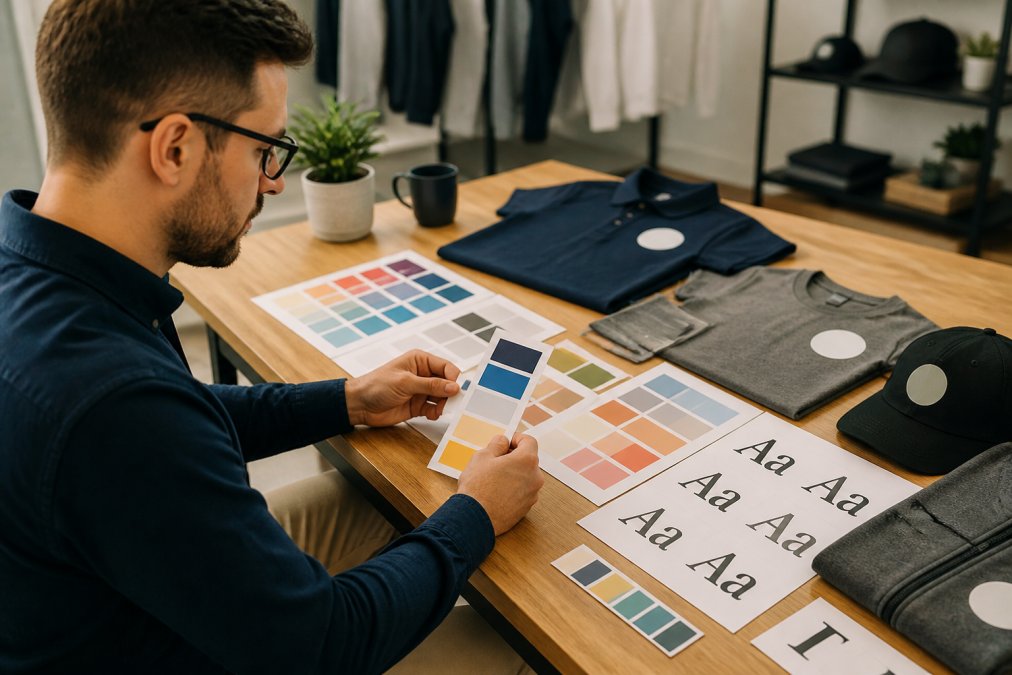
Avoid trendy colors that date quickly. Timeless colors like navy, black, white, gray, and earth tones hold up better.
Best Promotional Products for Corporate Events
Strategic apparel selection requires understanding cost-per-wear, perceived value, and return on investment.
Divide your apparel strategy into three tiers: Premium (embroidered jackets and pullovers for VIPs), Core (polo shirts and caps for all attendees), and Utility (tote bags and water bottles for wide distribution).
Measure success by cost-per-wear: a jacket worn 100 times costs less per wear than a t-shirt worn five times. Quality items outperform cheap alternatives. To estimate ROI, calculate: (attendees × annual wear frequency × impressions per wear × impression value) ÷ apparel cost.
Corporate attendees notice fabric quality immediately. Thin cotton pills easily; mid-weight cotton lasts years. For embroidery, use polyester thread (holds color better) for a durable, clean finish.
Modern corporate buyers expect eco-friendly materials. Organic cotton appeals to environmentally conscious attendees. Recycled polyester carries sustainability messaging. Communicate this clearly: "Made from 100% organic cotton" or "Fabric contains 50% recycled polyester."
When you design branded gear, choose items that solve real problems for your audience. Financial services firms prioritize embroidered polo shirts; tech companies choose hoodies and tote bags; construction events select moisture-wicking t-shirts and caps. Balance appropriateness, durability, and post-event utility to create lasting brand assets rather than disposable swag.
Bulk Screen Printing for Events: Technical Specifications
When ordering branded gear in volume, technical specifications matter. One wrong file format or resolution can ruin your entire print run.
Use vector files (EPS, AI, PDF). Specify Pantone colors and whether you're using RGB or CMYK. Screen printing is cost-effective for bulk orders. Standard production and rush options are available.
Ask your printer about their specific technical requirements before finalizing your design. Different printing methods (screen printing, embroidery, direct-to-garment) have different file and size specifications.
Custom Apparel Design Tips and Logo Placement
Logo placement determines brand visibility and perceived value.
Best placements: chest (professional, visible), back (bold impact), sleeves (subtle), cap front (high visibility).
Plan for Post-Event Utility and Brand Longevity
The best branded gear works hard long after the event ends. Every time someone wears or uses your apparel, your brand gets visibility. But designing for post-event utility requires intentional choices about materials, functionality, and sustainability, not just hoping attendees keep what you give them.
Design for Actual Use Cases:
- Gym or athletic wear? Choose moisture-wicking fabrics, reinforced seams, and colors that hide sweat stains.
- Work apparel? Stick to professional colors and styles that fit dress codes. Avoid trendy graphics that look dated in six months.
- Casual everyday wear? Design for versatility, neutral colors, timeless graphics, comfortable fit that works with multiple outfits.
- Functional utility items? Tote bags need reinforced handles and interior pockets. Water bottles need durable lids and non-slip bases. Hats need adjustable sizing.
Material Selection for Longevity:
Cotton options:
- Standard cotton (150 GSM or lower): Thin, pills easily, fades quickly. Typical lifespan: 1-2 years of regular wear.
- Mid-weight cotton (180-220 GSM): Feels substantial, resists pilling, maintains shape. Typical lifespan: 3-5 years.
- Organic cotton (180-220 GSM): Same durability as conventional mid-weight cotton, but grown without synthetic pesticides. Costs 15-25% more. Appeals to environmentally conscious attendees and supports CSR messaging.
Synthetic and blended options:
- Cotton-polyester blend (50/50 or 60/40): Resists wrinkles, maintains color, dries faster than 100% cotton. Typical lifespan: 3-5 years. Cost-effective for large orders.
- Recycled polyester: Made from post-consumer plastic bottles. Functionally equivalent to virgin polyester but carries sustainability messaging. Costs similar to virgin polyester. Ideal for eco-conscious brands.
- Performance fabrics (moisture-wicking blends): Designed for athletic use. Higher cost ($18-$25 per unit) but justify premium pricing through functionality and durability.
Sustainability and Brand Values:
Common sustainable options:
- Organic cotton: Certified by GOTS (Global Organic Textile Standard). No synthetic pesticides, lower water usage than conventional cotton.
- Recycled polyester: Diverts plastic waste from landfills. Functionally identical to virgin polyester but with environmental benefit.
- Bamboo fabric: Soft, breathable, biodegradable. Slightly higher cost but premium feel.
- Linen blends: Durable, breathable, naturally antimicrobial. Higher cost but excellent for warm-weather events.
Design for Timelessness:
Timeless design principles:
- Use classic colors: navy, black, white, gray, earth tones, or your brand's core colors. Avoid trendy neons or pastels.
- Keep graphics simple and clean. Intricate, detailed artwork becomes cluttered when printed small.
- Avoid year-specific references (event dates, trendy phrases). If you must include a date, make it subtle (small print on sleeve or back neck).
- Use your brand logo as the primary graphic. Logos age better than custom illustrations.
- Test your design against apparel from 5-10 years ago. Does it still look good? If not, it's too trendy.
Build in Functional Features:
- Pockets: A hoodie with a kangaroo pocket feels more valuable than one without. Attendees use pockets daily.
- Zippers: Full-zip hoodies are more versatile than pullover styles. They layer better and work in more situations.
- Reinforced seams: Double-stitched seams on tote bags and jackets last longer and signal quality.
- Adjustable sizing: Hats with adjustable back straps fit more people. Tote bags with adjustable straps work for different body types.
- Interior pockets or organization: Tote bags with interior zippered pockets become everyday work bags. Water bottles with non-slip bases stay in gym bags.
Measure Post-Event Wear Rates:
- "How many times per week do you wear [apparel item]?"
- "In what situations do you wear it? (gym, work, casual, other)"
- "Would you wear this item again if we gave you another one?"
The Full Lifecycle Perspective:
Think about your apparel's complete journey:
- Event day: Attendee receives gear, wears it during the event.
- First month: Does it get worn regularly, or does it sit in a closet?
- First year: How many times is it worn? Is it still in good condition?
- Years 2-3: Does it remain a go-to item, or has it been replaced?
- End of life: Does it get donated (extending your brand's reach), recycled, or discarded?
Frequently Asked Questions
What makes event merchandise successful?
Successful event merchandise balances brand visibility with wearability. The design must reflect your brand identity through consistent color palette and typography, incorporate sponsor placement strategically, and remain functional after the event ends. Quality construction ensures the gear withstands multiple washes without fading or peeling. Items that attendees actually wear and keep, like fitted apparel rather than oversized giveaways, extend your brand recognition long after the event closes.
How far in advance should you order branded event gear?
For bulk screen printing for events, order in advance of your event date. This timeline allows for design approval, production scheduling, and quality checks. Rush orders are possible. If your event is in 3 weeks or less, confirm availability with your printer immediately. Lead time depends on quantity, customization complexity, and the printing method (embroidery takes longer than screen printing).
What are the best design practices for promotional clothing?
Follow these custom apparel design tips: keep logos sized proportionally to the garment, use high-contrast colors against the base fabric, maintain visual hierarchy so your brand stands out without overwhelming the design, and ensure all text is legible at arm's length. Use vector graphics for crisp reproduction, and test your design on the actual garment color before finalizing production.
How do you choose the right apparel for an event?
Consider your target audience, event environment, and brand personality. Corporate clients typically prefer fitted polos or structured jackets; construction crews may need durable work shirts; casual events suit t-shirts or hoodies. Check the event venue temperature and duration, then select fabrics suited to those conditions. Best promotional products for corporate events often include versatile pieces like performance polos or quarter-zip pullovers that attendees wear beyond the event. Avoid one-size-fits-all sizing; offer multiple fits to increase actual wear.