 how-to
How to Design Professional Uniforms: A 2026 Guide
Table of Contents
- Step 1: Define Your Brand Identity and Uniform Goals
- Step 2: How to Choose Promotional Apparel for Your Team
- Step 3: Select the Best Fabrics for Professional Uniforms
- Step 4: Establish Uniform Branding Guidelines
- Step 5: Use Digital Prototyping and Employee Feedback
- Step 6: Plan for Uniform Lifecycle Management and Compliance
- Common Mistakes to Avoid When Designing Professional Uniforms
- Frequently Asked Questions
Last Updated: September 10, 2026
Step 1: Define Your Brand Identity and Uniform Goals
Designing professional uniforms starts with your brand, not your fabric swatches. At Logo Concepts & Printing, we've spent over 25 years helping teams translate brand identity into apparel employees actually want to wear. The businesses that get this right treat uniforms as a marketing channel, not a procurement chore.
Professional uniforms are branded garments issued to employees that combine functional workwear requirements with consistent visual identity. They differ from generic work shirts because every design decision, from color palette to logo embroidery, traces back to a documented brand standard.
Start by auditing three things: your logo files, your color codes, and your customer-facing materials. If your signage and website use one shade of blue and your work shirts use another, customers notice the mismatch.
Audit Your Visual Brand Elements
Pull your brand assets together before you talk to any vendor. You need vector logo files, exact color values, and a clear sense of where the uniform will appear, whether that's a retail counter or a job site.
- Logo files: Request vector formats from whoever designed your brand
- Color values: Note the exact codes, not just "navy" or "forest green"
- Typography: Identify fonts used on signage and print materials
- Usage rules: Document minimum logo sizes and required clear space
U.S. Small Business Administration brand guidance offers a useful primer on why consistent visual identity supports recognition across every customer touchpoint.
Step 2: How to Choose Promotional Apparel for Your Team
Matching garment style to the actual work environment prevents the most expensive mistake in uniform programs: buying apparel that employees refuse to wear. A polo that works in a showroom fails on a service bay floor. Ask each department what they do in a typical shift, reaching overhead, kneeling, working near heat, or sitting at a desk all point to different ergonomic cuts and garment functionality.
Match Garment Style to Work Environment
| Environment | Best Garment Type | Key Feature |
|---|---|---|
| Office and front desk | Woven button-down, polo | Wrinkle resistance |
| Retail floor | Polo, light jacket | Stain release finish |
| Trade and service | Work shirt, hi-vis vest | Reinforced seams |
| Events and promo | T-shirt, hoodie | Print-friendly surface |
Step 3: Select the Best Fabrics for Professional Uniforms
The best fabrics for professional uniforms balance breathability, durability, and appearance retention against wash frequency. Cotton feels comfortable but shrinks and fades; synthetic blends hold color and shape but can trap heat. The fiber is only half the story, fabric weight, weave, and finish determine how a garment performs on the job and how long it survives the laundry cycle.
Read the Fabric Spec, Not Just the Fiber
When a vendor quotes a fabric, ask for four numbers: fiber content, fabric weight in ounces per square yard (oz/yd²), weave type, and any performance finish. Those four data points predict almost everything about how the garment will wear.
- Fiber content: The percentage breakdown, not just the dominant fiber. A 60/40 cotton-poly behaves very differently from a 50/50 blend.
- Fabric weight: Measured in oz/yd². Lightweight knits (roughly 4-5 oz/yd²) suit indoor and warm-weather roles. Midweight (6-7 oz/yd²) is the workhorse range for polos and tees. Heavyweight (8 oz/yd² and up) is for work shirts and outerwear that need to hold up to abrasion.
- Weave or knit structure: Poplin and twill wovens resist wrinkles; jersey knits stretch and breathe; pique knits add texture that hides soil.
- Performance finish: Moisture-wicking, soil release, antimicrobial, and wrinkle-resistant finishes are applied after the fabric is made and can wash out over time.
Fabric Options by Fiber and Use Case
- Moisture-wicking polyester: Best for active roles and warm environments. Look for 4-5 oz/yd² fabrics with a mechanical (not just chemical) wick so performance survives repeated laundering.
- Cotton-poly blend: Balances comfort with color retention. Blends in the 5-6.5 oz/yd² range are standard for embroidered polos because the poly content gives the fabric the dimensional stability embroidery needs.
- 100% cotton: Soft and breathable, but expect shrinkage of roughly 3-5% on the first wash unless pre-shrunk or garment-washed. Ring-spun cotton is softer and prints better than open-end cotton.
- Performance knits: Hold shape through repeated industrial laundering. Typically polyester or poly-spandex, specified when a garment will be washed at high temperature or with harsh chemicals.
- Stretch wovens: Poly-spandex or cotton-spandex blends that add mobility for reaching, bending, or kneeling. Common in service and trade uniforms where a rigid woven restricts movement.
Match Fabric to Wash Cycle and Environment
Teams often buy fabric for appearance, then discover it can't survive the operation's actual wash routine. Before you commit, answer three questions:
- Who washes the garment? Home laundering is gentler than a commercial or industrial laundry. Industrial laundering uses higher temperatures and stronger chemistry, which breaks down cotton faster and can strip applied finishes.
- How often? A garment worn and washed five days a week will reach end of life far sooner than one worn twice a week, even in the same fabric.
- What's the environment? Heat, grease, chemicals, and abrasion each point to different fabric specs. A soil-release finish matters in food service; abrasion resistance matters in trades.
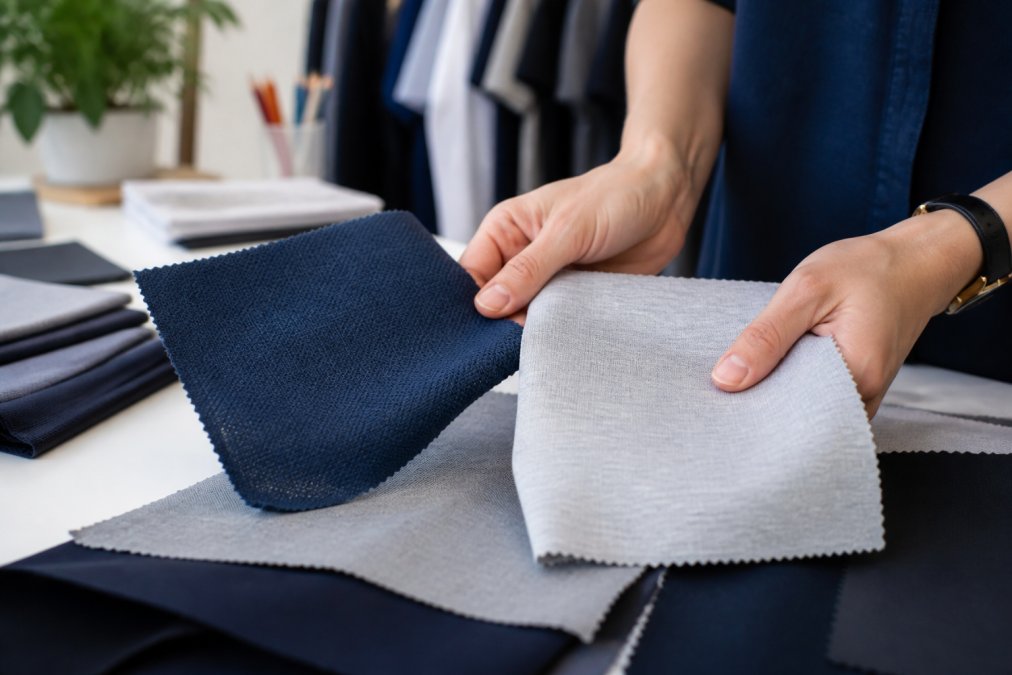
Ask your vendor for a fabric swatch before committing to a full run. Textile quality varies widely within the same fiber category, and a swatch costs nothing compared to replacing an entire order. Wash it two or three times the way your team will wash the finished garment and check for shrinkage, pilling, and color loss before ordering.
Step 4: Establish Uniform Branding Guidelines
Uniform branding guidelines document exactly how your logo, colors, and name appear on every garment. Without them, decoration varies across departments and vendors, and your professional image suffers when customers are looking. Make it a written document, not a verbal understanding, so any vendor can produce a matching garment.
Lock Down Logo Placement First
Left chest is the default for corporate apparel because it reads clearly at conversation distance and sits above most garments' natural fold lines. Sleeve and back placements suit larger graphics or event gear. Decide and document:
- Placement location: Left chest, right chest, sleeve, back yoke, or a combination. Specify the measurement from a fixed reference point (for example, "centered on left chest, 7-9 inches below the shoulder seam") so vendors reproduce it consistently.
- Logo size: Give a minimum and maximum width in inches. A logo that reads well at 3.5 inches on a polo can look undersized on a jacket back.
- Color treatment: Specify whether the logo appears in full brand color, one-color, or tonal (same color as the garment). One-color versions are often needed for embroidery on dark fabrics.
- Clear space: Define the minimum empty margin around the logo so it never crowds a seam, pocket, or placket.
Logo Placement and Decoration Methods
- Embroidery: Durable and professional, ideal for polos and outerwear. Best for logos with solid shapes and limited colors. Fine detail, small text, and tight gradients don't reproduce well because the stitch count can't resolve them.
- Screen printing: Cost-effective for larger runs and bold graphics. Each color requires its own screen, so cost scales with color count. Plastisol inks sit on top of the fabric and can crack if stretched; water-based and discharge inks penetrate the fabric and feel softer but have a shorter shelf life.
- Heat transfer: Best for detailed multicolor logos and small batches. No screen setup cost, making it economical for short runs, but the transfer can peel if washed at high heat or dried on a hot setting.
- Woven patches: Premium look for caps and workwear. The patch is sewn or heat-sealed on, adding a step but producing a crisp, durable result on structured garments.
Embroidery handles fine detail poorly but survives hundreds of wash cycles; screen printing captures gradients but can crack if stretched. For most teams, embroidery on structured garments and screen printing on tees covers the full range.
Decoration Can Affect Safety Ratings, Check Before You Print
This is the step most guides skip, and it can create real liability. When a garment is certified to a safety standard, flame-resistant (FR) apparel, high-visibility vests, or arc-rated clothing, the certification applies to the garment as manufactured. Adding decoration can change how it performs.
- Flame-resistant apparel: Embroidery thread, patches, and heat-transfer films can introduce a material that isn't FR-rated. Many FR programs require decoration by a vendor certified to the manufacturer's specification, and some manufacturers limit decoration to specific areas or thread types.
- High-visibility garments: A large logo or patch over reflective tape can reduce the visible surface area the standard requires. Placement matters as much as the decoration method.
- Arc-rated clothing: Decoration that melts or ignites under arc exposure defeats the garment's purpose. Only non-melting materials should be used.
Before finalizing any design on a safety-rated garment, confirm with the garment manufacturer which decoration methods and placements preserve the rating, and keep that documentation on file. Check the Occupational Safety and Health Administration standards for the requirements that apply to your operation.
Document the Guidelines and Share Them
Write the guidelines into a single reference document: vector logo files, exact color values, approved placements with measurements, approved decoration methods per garment type, and any safety-related restrictions. Share it with every vendor and keep it updated. When a new department orders uniforms, the guidelines keep the program visually consistent without a redesign every time.
Step 5: Use Digital Prototyping and Employee Feedback
Digital prototyping lets you approve a design mock-up before anything goes to print, preventing the costly surprise of a misplaced logo. This is the step most teams rush, and it determines whether your team actually wears the result.
Collect employee feedback during prototyping, not after delivery. Ask a representative group from each department to review the mock-ups for fit, comfort, and practicality. Staff who help choose the design wear it with more pride, which shows in how they interact with customers.
Step 6: Plan for Uniform Lifecycle Management and Compliance
Uniform lifecycle management means tracking garments from issue through replacement so you always know what's in service and what needs reordering. Most companies skip this and end up with mismatched shirts across departments. Set a replacement schedule based on wash frequency and fabric wear, daily-wear polos may need replacing far sooner than a jacket worn twice a week.
Industry-specific compliance matters too. If your team works around electrical hazards, near moving machinery, or with chemicals, your apparel must meet the applicable safety standards, and decoration methods can affect whether a garment still qualifies. Check the Occupational Safety and Health Administration standards for the requirements that apply to your operation before finalizing any design.
Common Mistakes to Avoid When Designing Professional Uniforms
The fastest way to waste a uniform budget is to order before you've tested. The mistakes we see most often:
- Choosing style over function: A sharp-looking garment employees won't wear is a sunk cost
- Skipping the mock-up: Unapproved logo placement means reprints and delays
- Ignoring size inclusivity: Ordering only standard sizes leaves team members without a proper fit
- Forgetting garment maintenance: Without care instructions, colors fade and prints crack early
- Overlooking compliance: Safety-related apparel must meet standards before decoration
Federal Trade Commission guidance on textile labeling explains the care and content labeling requirements that apply to apparel sold in the market, which helps you set realistic expectations for washing and wear.
Getting a uniform program right takes planning, but the payoff is a team that looks consistent and feels considered. Logo Concepts & Printing handles the entire process, from in-house graphic design and campaign development to fast digital mock-ups you approve before anything goes to print. With thousands of customizable items through our iPromoteu affiliation, we match the right garment, fabric, and decoration to your brand and budget. Contact us today to start your uniform program.
Frequently Asked Questions
How can I design my own work uniform?
Start by defining your brand identity and uniform goals, then choose promotional apparel that fits your work environment. Select fabrics based on durability and comfort, and establish clear uniform branding guidelines for logo placement. Use digital mock-ups to get employee feedback before production. Working with a vendor that offers in-house design support can simplify the process.
What are the key elements of a professional uniform design?
Professional uniforms combine brand identity, garment functionality, and employee comfort. Key elements include a consistent color palette, appropriate fabric for the work environment, ergonomic cuts, and clear logo placement. Uniform branding guidelines should specify decoration methods like embroidery or screen printing. Size inclusivity and moisture-wicking properties matter for daily wear. A uniform policy that balances professionalism with practicality helps ensure team consistency and a positive customer perception.
How do I choose the right fabric for company uniforms?
Match fabric to your industry and climate. For active roles, moisture-wicking polyester blends offer breathability and durability. For office settings, cotton or cotton-poly blends provide a polished look. Consider fabric durability against frequent washing, and check for colorfastness to maintain brand colors. Ergonomic cuts and stretch materials improve comfort. Request fabric swatches and test samples before bulk ordering, especially if your team works in varied conditions.
What are the industry standards for professional uniform branding?
Industry standards for uniform branding guidelines focus on consistency and visibility. Logo embroidery is common for polos and jackets, while screen printing suits t-shirts and event apparel. Placement should be uniform across garments, typically left chest or sleeve. Colors must match your brand palette precisely. For safety-sensitive industries, high-visibility standards from OSHA may apply. Always request a digital mock-up and physical sample to approve logo placement before production.