 ultimate-guide
Managing Brand Identity Across Merchandise
Table of Contents
- What Brand Identity Means for Merchandise
- Key Elements of Brand Identity on Physical Products
- Is It Legal to Put Your Own Label on Clothing
- Brand Consistency Checklist for Promotional Products
- Best Practices for Logo Placement on Apparel
- Scaling Your Brand System Across Touchpoints
- Quality Control and Brand Integrity
- Frequently Asked Questions
Last Updated: September 27, 2026
What Brand Identity Means for Merchandise
Brand identity is the collection of visual, verbal, and experiential elements that distinguish your business. When applied to merchandise, it becomes a physical extension of your company's promise to customers, communicating who you are and why someone should trust you.
Merchandise serves as a walking advertisement that stays visible for months or years. A poorly executed logo placement or faded print undermines your credibility, while well-designed branded items build recognition and loyalty. This permanence makes managing brand identity across merchandise critical.
At Logo Concepts & Printing, we've worked with banks, automotive dealerships, construction companies, and investment firms who recognize that managing brand identity across merchandise is about creating a cohesive system that reinforces brand perception at every touchpoint.
Inconsistent branding on merchandise creates confusion and signals disorganization. Consistency, by contrast, signals competence and builds trust.
Key Elements of Brand Identity on Physical Products
Managing brand identity across merchandise requires understanding which elements translate from digital to physical. The technical handoff between design and production is where most brand inconsistencies originate.
Visual Elements and Design Standards
Your logo, color palette, typography, and imagery must remain consistent across all merchandise, though physical products impose constraints that digital platforms don't.
Logo File Preparation and Specifications
Logo size, file format, and construction all matter on apparel. A logo perfect at 200 pixels on a website may be unreadable when embroidered at 2 inches.
Prepare logos in vector format (Adobe Illustrator .ai or .eps files, or PDF vector). Raster files (JPG, PNG) pixelate when enlarged and are unsuitable for embroidery or screen printing.
Provide logo files at multiple scales: full-color, one-color for embroidery, and reverse (white) for dark fabrics. Document minimum reproduction size.
Include a technical brief with each logo file specifying: intended production method, approved color values, and minimum clear space.
Color Accuracy Across Production Methods
Screen colors don't always match printed or embroidered colors depending on fabric type, ink chemistry, thread dye lot, or production method.
Request Pantone color specifications for all brand colors. Pantone is the industry standard for color matching across vendors and production methods (PANTONE® USA | Pantone Color Systems).
Specify Pantone Uncoated values for fabric.
Request physical color samples on the exact fabric you've selected. Approve samples in person under natural lighting, not on a computer screen, to prevent costly reprints.
For embroidery, specify thread colors by manufacturer and color number, not by visual description.
Typography on Merchandise
Thin, delicate fonts may not translate well to screen printing or embroidery. Sans-serif fonts typically perform better on physical products.
Test fonts at actual merchandise sizes. If your brand font isn't available to the vendor, establish an approved fallback font that maintains brand voice.
For embroidered text, use fonts with consistent stroke width.
Brand Voice and Messaging on Merchandise
Taglines and supporting text on merchandise should reflect your brand voice and align with how your audience expects to hear from you.
Copy placement matters. Text positioned awkwardly or cramped appears unprofessional and undermines brand perception.
Specify exact copy placement using a technical diagram or mockup to eliminate ambiguity and prevent costly repositioning.
Is It Legal to Put Your Own Label on Clothing
Yes, it is legal to put your own label on clothing, provided you comply with federal labeling requirements.
Federal regulations require all textile products sold to carry a label disclosing fiber content, country of origin, and manufacturer or distributor name and address (the FTC). When you put your own label on clothing, you become responsible for compliance.
If you source blank apparel and add your own branding, you must add a compliant fiber content label stating fiber percentages, country of origin, and your company's name and address.
Responsibility falls on you, the party putting your label on the garment. Working with vendors who understand these requirements protects your business from enforcement action.
Brand Consistency Checklist for Promotional Products
Maintaining brand consistency across promotional products requires a systematic approach and clear standards.
Create a written brand guidelines document for merchandise including: logo specifications, color palette (Pantone values), typography, messaging standards, and quality standards.
Before sending designs to production, verify: logo size and placement, color accuracy, typography standards, brand voice compliance, FTC labeling compliance, quality specifications, and stakeholder approval.
Having a single point of approval prevents inconsistency and protects brand integrity.
Best Practices for Logo Placement on Apparel
Logo placement dramatically affects brand perception. Well-placed logos look intentional and professional; poor placement appears careless.
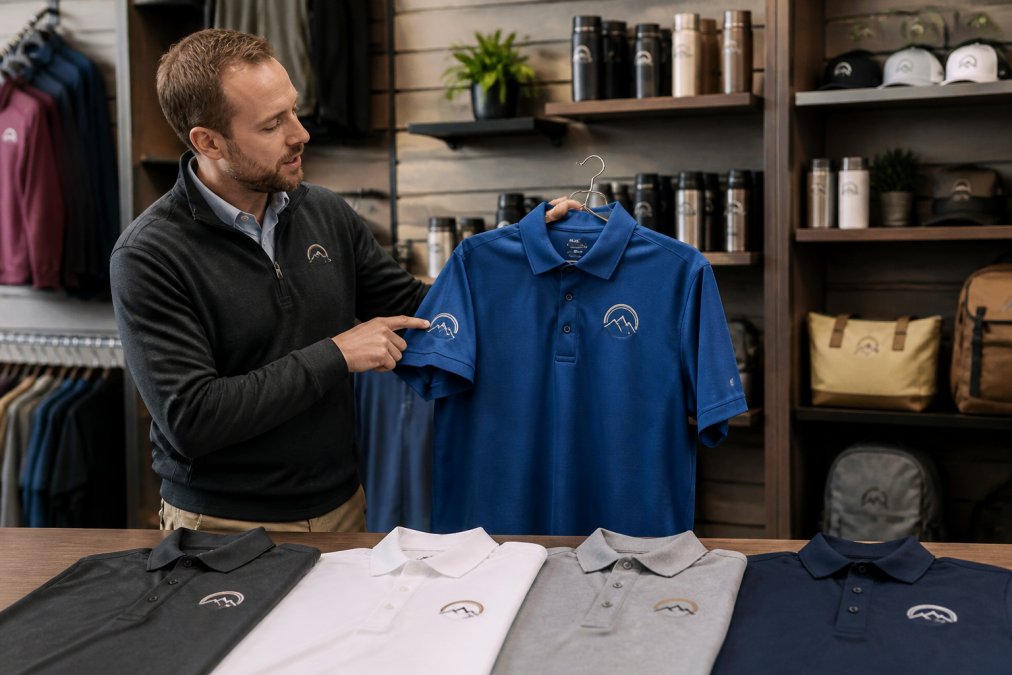
Standard placements include the left chest (most common), back neck, or sleeve. Chest placement works best because it's visible and doesn't interfere with movement.
A chest logo typically measures 2 to 3 inches wide. Smaller logos risk being too subtle; larger logos (over 4 inches) can overwhelm the garment.
Avoid placements covered by accessories, interfering with movement, or at sleeve seams, which may not embroider cleanly.
Test logo placement on actual garment samples before full production.
Scaling Your Brand System Across Touchpoints
As your business grows, managing brand identity across merchandise becomes more complex across employee uniforms, trade show giveaways, client gifts, and events.
Quality Control and Brand Integrity
Quality directly impacts brand perception. A faded logo after one wash, thread that unravels, or print that cracks communicates negligence. Conversely, merchandise that looks and feels premium reinforces your brand's value. Yet most businesses lack a formal quality audit process, leaving brand integrity to chance.
Building a Quality Audit Framework
Implement quality checks at multiple stages: pre-production, in-process, and post-production. Each stage serves a different purpose.
Pre-Production Approval
- Does the logo match your approved size and placement specifications?
- Do colors match your Pantone samples?
- Is text legible and positioned correctly?
- Does the overall appearance feel consistent with your brand standards?
In-Process Quality Checks
Common in-process issues include:
- Color drift (later units printed slightly different from earlier units)
- Embroidery tension problems (stitches too loose or too tight)
- Print misalignment (logo shifted left, right, up, or down)
- Fabric defects (holes, stains, weaving errors in the blank garment)
Post-Production Inspection
For each inspected unit, check:
- Logo placement and size accuracy
- Color consistency (compare to approved sample)
- Print or embroidery quality (no fading, cracking, unraveling, or misalignment)
- Seam quality (no loose threads, broken stitches, or puckering)
- Fabric quality (no holes, stains, or defects)
- Labeling accuracy (FTC-compliant fiber content and country-of-origin labels present and legible)
Durability Testing and Brand Longevity
Merchandise that fails after minimal use damages brand perception more than no merchandise at all. A t-shirt that shrinks after one wash, or embroidery that unravels after a few wearings, signals that your brand cuts corners.
Wash Testing: Wash embroidered or printed items 5-10 times using standard household detergent and warm water. Inspect for:
- Print cracking or fading
- Thread unraveling or color bleeding
- Fabric shrinkage or pilling
- Label degradation
Wear Testing: Have team members wear sample items for 2-4 weeks in normal working conditions. Collect feedback on:
- Comfort and fit
- Durability of seams and hems
- Logo visibility and condition after regular wear
- Overall impression of quality
Vendor Accountability and Quality Standards
Communicate quality expectations in writing before production begins. Include a quality standards clause in your purchase agreement specifying:
- Acceptable defect rate
- Specific quality metrics (e.g., "embroidery thread tension must be consistent across all units")
- Consequences for non-compliance (rework at vendor expense, partial payment withholding, or termination)
- Right to inspect and approve samples at each production stage
- Warranty period
The Cost of Quality vs. Brand Risk
The cost difference between quality merchandise and cheap alternatives is often smaller than businesses expect. Quality merchandise with professional embroidery builds brand perception, while bargain options with poor embroidery can damage it.
Frequently Asked Questions
What are the key elements of brand identity for merchandise?
Brand identity on merchandise includes your logo design, color palette, typography, tagline, and overall visual style. These elements work together to create recognition and trust. When applied consistently across apparel, hats, bags, and other promotional products, they reinforce your brand message and make your business memorable to customers and employees alike.
Is it legal to put your own label on clothing for resale?
Yes, you can put your own label on clothing, but you must comply with federal labeling requirements. Your label must include fiber content, country of origin, and manufacturer or distributor name and address. If you're reselling items, ensure you own the right to relabel them and that you don't infringe on existing trademarks or copyrights.
How do I maintain brand consistency across different merchandise suppliers?
Create detailed brand guidelines that specify logo files, color codes (Pantone, CMYK, RGB), approved fonts, sizing requirements, and placement rules. Share these standards with every supplier before production begins. Request sample approvals before full runs, and perform quality checks on finished products. Regular communication and written agreements help ensure every item meets your brand standards regardless of the vendor.
Where should logos be placed on apparel for maximum impact?
Chest placement is standard for shirts and creates immediate brand visibility. Sleeve logos work well for secondary branding. Back placement suits larger designs and jackets. Consider the garment type, intended wear, and visibility from a distance. Test placement on mockups before production. Avoid overcrowding; one or two strategic placements are more professional than multiple logos on a single item.
How can small businesses scale brand identity through promotional products?
Start with core items like t-shirts and hats using your primary logo. Document your brand guidelines in a simple one-page checklist. As you grow, expand to complementary products like bags, drinkware, or outerwear while maintaining consistent visual identity. Use digital asset management to store approved logo files and color specifications. Partner with suppliers experienced in custom merchandise who understand brand consistency requirements.
What should I include in a brand consistency checklist for promotional products?
Your checklist should cover logo file formats and sizes, approved color variations, typography rules, spacing and margins around logos, acceptable backgrounds, placement guidelines for each product type, quality standards for printing or embroidery, and approval processes. Include examples of correct and incorrect applications. Review this checklist before ordering any merchandise to catch errors early and protect your brand equity.