 how-to
Design Custom Flags for Car Sales Events: 7-Step Guide
Table of Contents
- Why Custom Flags Matter at Car Sales Events
- Step 1: Choose Your Flag Format and Shape
- Step 2: Plan Size and Placement for Maximum Visibility
- Step 3: Apply Flag Design Best Practices
- Step 4: Craft Your Message and Call to Action
- Step 5: Decide Between Single-Sided and Double-Sided Flags
- Step 6: Select Materials and Print Quality
- Step 7: Prepare Artwork and Submit for Production
- Frequently Asked Questions
Last Updated: October 17, 2026
Why Custom Flags Matter at Car Sales Events
Custom flags car sales events are one of the most effective tools for driving foot traffic and building brand visibility on a dealership lot.
The challenge most dealerships face is simple: how do you design a flag that actually works? A poorly designed flag gets lost in the visual noise. It fails to convert attention into foot traffic.
At Logo Concepts & Printing, we've helped automotive dealerships design flags that deliver measurable results. The difference between an average flag and a high-performing one comes down to intentional design choices.
Step 1: Choose Your Flag Format and Shape
Your flag format determines how visible it will be from different angles and distances. Not all formats work equally well for car sales events. The wrong choice wastes your budget. The right choice multiplies your impact.
Three formats dominate dealership marketing: feather flags, teardrop flags, and rectangular banners. Each has specific advantages depending on your lot layout and traffic patterns.
Feather Flags for High-Visibility Impact
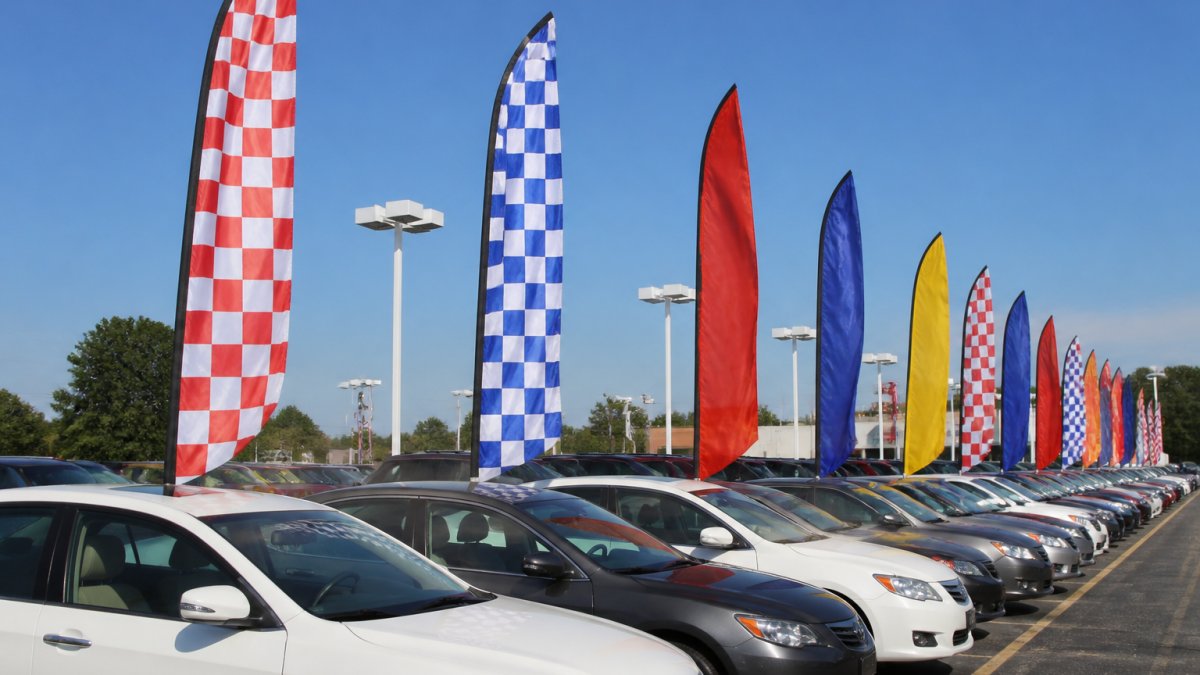
Feather flags are the most popular choice for car dealerships. They're tall, they move in the wind, and they catch the eye from far away. A feather flag can reach significant heights, making it visible from a distance.
Feather flags work best when you need to draw attention from the street. Place them at lot entrances, along roadside frontage, or near major intersections. The vertical orientation means they occupy minimal ground space while delivering maximum visibility.
The downside: feather flags require sturdy ground stakes or weighted bases. Windy conditions can topple lightweight setups. You'll also need dedicated space to install them without blocking sightlines.
Teardrop and Rectangular Flags for Lot Coverage
Teardrop flags are smaller and more nimble than feather flags. They work well for mid-lot placement. Use them to highlight specific vehicles, create pathways through your inventory, or mark promotional zones.
Rectangular flags (also called banner flags) are horizontal and compact. They're ideal for attaching to existing structures like lamp posts or fence lines. They take up less visual real estate but still command attention.
Rectangular flags work best when you're short on ground space or want to create a cohesive visual line across your lot.
Choose your format based on your lot's layout and your visibility needs. A large corner lot with heavy street traffic calls for feather flags. A smaller lot or one with existing structures benefits from teardrop or rectangular options.
Step 2: Plan Size and Placement for Maximum Visibility
Size and placement determine whether your flag gets seen. A flag hidden behind vehicles or trees delivers zero results. A flag positioned for sightlines drives consistent foot traffic.
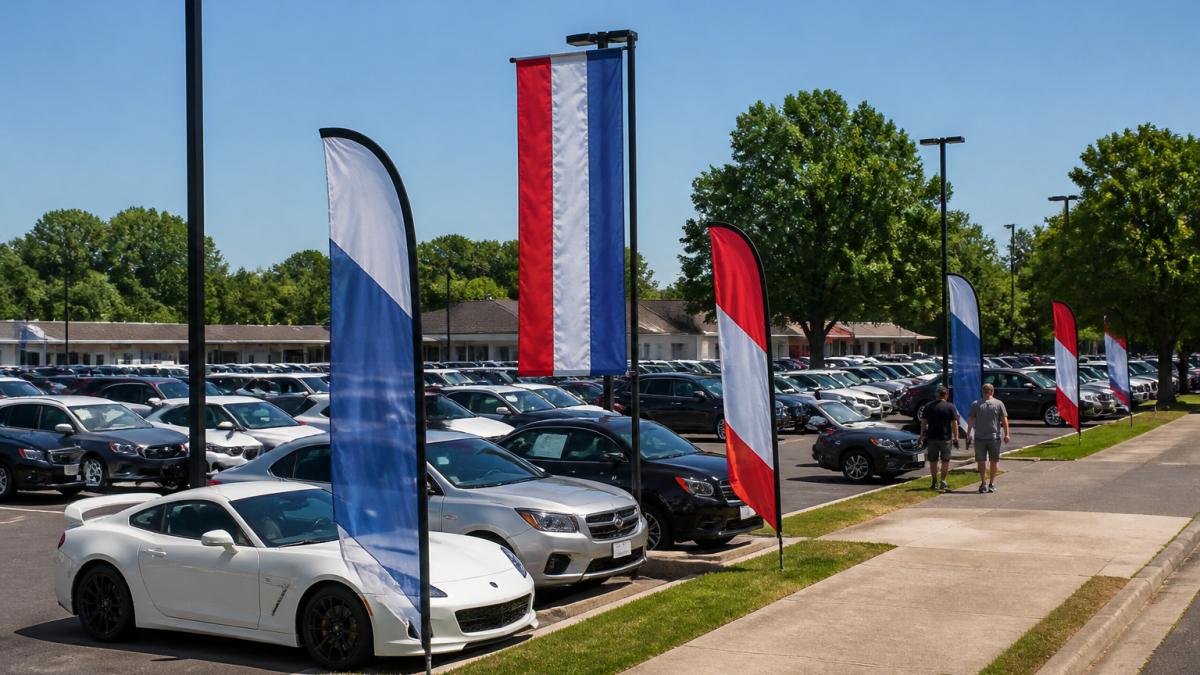
Start by mapping your lot. Identify where customers enter and exit. Note which vehicles draw the most attention. Mark sight lines from the street and from parking areas.
Larger flags work best at lot perimeters and entrances. Smaller flags work better in mid-lot areas where they can highlight specific vehicle sections without overwhelming the space.
Height matters too. A flag that's too low gets hidden behind vehicles. A flag that's too high looks disconnected from your lot.
Wind patterns affect placement. Flags in open areas need stronger bases. Flags near buildings may catch wind tunnels.
Step 3: Apply Flag Design Best Practices
Flag design best practices ensure your message reads clearly and your brand stands out. Poor design choices kill performance. Smart design choices multiply your results.
Three elements matter most: color selection, typography, and logo placement. Get these right and your flag works. Get them wrong and it becomes background noise.
Color Selection and High Contrast
Your flag's color palette must create high contrast. A flag that blends into the sky or the lot's surroundings gets ignored. A flag with bold, contrasting colors stops traffic.
Use no more than two or three colors. Too many colors create visual confusion. Black and white deliver the highest contrast. Blue and yellow, red and white, and green and white all perform well.
Avoid color combinations that clash or reduce readability:
- Light colors on light backgrounds (yellow on white)
- Dark colors on dark backgrounds (navy on black)
- Colors that are similar in brightness (light blue and light green)
Test your color choices by viewing them from 50 feet away. If the contrast disappears at that distance, choose bolder colors.
Typography and Readability at Distance
Your text must be readable from a moving vehicle. A customer driving past your lot has 3 to 5 seconds to read your flag. Tiny text fails. Bold, large text works.
Use sans-serif fonts (Arial, Helvetica, Verdana) for maximum readability. Avoid decorative or script fonts. They look nice at close range but become unreadable from a distance.
Keep your font size large. Text should occupy at least 40% of your flag's visual area. A good rule: if you can't read it from 30 feet away, make it bigger.
Limit your text to 5 to 7 words maximum. A flag isn't a billboard. Short, punchy messages work best:
- "HUGE SAVINGS"
- "ZERO DOWN"
- "YEAR-END CLEARANCE"
- "LIMITED TIME OFFER"
Logo Placement and Brand Consistency
Your dealership logo should be appropriately sized for your flag's total area. Too small and it gets lost. Too large and it overwhelms your message.
Place your logo in one of these positions:
- Top left or top right corner
- Bottom corner opposite your main message
- Center, if your message is short
Keep your logo simple. Complex logos with fine details don't reproduce well on flags. Simplify your logo if needed for flag production.
Use consistent brand colors for your logo. If your logo is red and white, use red and white throughout your flag. Consistency builds brand recognition.
Step 4: Craft Your Message and Call to Action
Your flag's message must answer one question: why should a customer stop and visit your lot?
Your message should focus on a single benefit or offer. "Zero Down" works. "Huge Savings" works. "Year-End Clearance" works. Generic messages like "Welcome" or "Visit Us" don't drive action.
Pair your message with a clear call to action. "DRIVE ONE TODAY" or "LIMITED TIME" creates urgency. "ENTER HERE" or "TURN LEFT" guides traffic.
Short promotional messages work best:
- Action-oriented: "SAVE NOW," "DRIVE TODAY," "GET APPROVED"
- Offer-focused: "ZERO DOWN," "HUGE REBATES," "SPECIAL FINANCING"
- Urgency-driven: "LIMITED TIME," "LAST CHANCE," "ENDING SOON"
Test your message before production. Ask yourself: would I stop for this message if I saw it on a flag? If the answer is no, your message needs work.
Step 5: Decide Between Single-Sided and Double-Sided Flags
Single-sided flags show your message on one side only. Double-sided flags display your message on both sides, doubling your visibility.
Single-sided flags cost less and work well when your lot has a clear traffic flow. Place them so customers see the message side as they approach.
Double-sided flags cost more but deliver better results when traffic approaches from multiple directions. They're ideal for high-traffic intersections or corner lots where customers approach from different angles.
Double-sided flags deliver better return on investment for many dealerships because they work regardless of approach direction.
If budget is tight, use double-sided flags at lot entrances and single-sided flags in mid-lot areas where traffic flows in one direction.
Step 6: Select Materials and Print Quality
Flag materials determine durability and color vibrancy. Poor materials fade quickly. Quality materials hold color and withstand weather.
Most flags use polyester fabric because it's durable, affordable, and prints well. Polyester resists fading better than cotton and handles wind without tearing.
Print quality matters as much as material. Digital printing delivers vibrant colors and sharp details. Screen printing is more affordable for large quantities but requires simpler designs.
Ask your printer about their durability guarantees. Quality flags should maintain color vibrancy for outdoor use. If a printer won't guarantee durability, choose another vendor.
Step 7: Prepare Artwork and Submit for Production
Artwork preparation determines whether your flag prints correctly or becomes a costly mistake. Wrong file formats, incorrect dimensions, or poor resolution waste time and money.
File Specifications and Design Software
Your printer needs artwork files in specific formats. Common formats include PDF, AI (Adobe Illustrator), and EPS. Ask your printer which format they prefer.
File dimensions must match your flag size exactly. A 12-foot feather flag requires artwork that's sized to those proportions. Incorrect sizing leads to stretched images or cut-off text.
Resolution matters for print quality. Use 300 DPI (dots per inch) for production files. Lower resolution produces blurry, pixelated output.
Use design software to create your artwork. Some software offers flag templates that simplify the process, while others give you more control for complex designs.
Approval Process and Quality Checks
Before production begins, request a digital proof from your printer. Review the proof carefully:
- Check text spelling and accuracy
- Verify color accuracy against your brand guidelines
- Confirm logo placement and size
- Ensure all design elements fit within the flag boundaries
Printers typically offer proof revisions. Use them. Catching errors before production prevents costly reprints.
Once you approve the proof, your printer begins production. Typical turnaround for custom flags depends on complexity and order quantity.
When your flags arrive, inspect them before installation:
- Check color accuracy
- Verify text clarity and readability
- Inspect seams and stitching for quality
- Confirm sizing matches your specifications
Designing custom flags for car sales events requires intentional choices at every step.
The process we've outlined here is the same one we use at Logo Concepts & Printing for automotive dealerships.
Ready to design flags that actually work? Let our 25+ years of experience in promotional products and graphic design work for you.
| Design Element | Best Practice | Why It Matters |
|---|---|---|
| Flag Format | Feather flags at entrances, teardrop/rectangular in mid-lot | Maximizes visibility from different angles |
| Size | 12-15 feet for perimeter, 8-10 feet for mid-lot | Ensures readability from distance |
| Color Contrast | Black/white or bold complementary pairs | Stops traffic from moving vehicles |
| Text Size | 40% of flag area, sans-serif font | Readable from 50+ feet away |
| Message Length | 5-7 words maximum | Captures attention in 3-5 seconds |
| Logo Size | 15-20% of flag area | Maintains brand consistency without overwhelming |
| Flag Sides | Double-sided for multi-directional traffic | Works regardless of approach direction |
| File Resolution | 300 DPI minimum | Ensures sharp, vibrant print quality |
A well-designed custom flag becomes a silent salesperson on your dealership lot. According to best practices in outdoor advertising, flags and banners rank among the highest-ROI promotional tools for retail environments because they deliver consistent, measurable visibility at a reasonable cost.
The difference between success and failure comes down to design. A flag that follows these principles will outperform generic alternatives.
Your next step is to map your lot, identify your target message, and start designing.
The best time to design your flags is before your sales event. The second best time is today.
Frequently Asked Questions
What should you put on a custom flag for a car sales event?
Keep your message short: include your dealership name or logo, a single promotional offer (like 'HUGE SALE' or '$0 Down'), and a clear call to action ('Visit Today' or 'Limited Time'). Avoid cluttering the flag with multiple messages or fine print. Buyers glancing from the road need to understand your offer in 2-3 seconds. High contrast between text and background ensures readability at distance, even at highway speeds.
What flag size and shape work best for a car sales event?
Feather flags create maximum visibility from the road and are ideal for lot entrances. Teardrop flags work well for mid-lot placement. Rectangular flags suit fence lines or building sides. Taller flags are visible from farther away; shorter flags work for foot-traffic areas. Choose based on your lot layout and sightlines from the main road, visibility wins sales.
How do you make text readable on a flag from the road?
Use large, bold fonts. Keep letters uppercase for clarity. Maintain high contrast between text color and background (dark text on light, or vice versa). Avoid thin fonts, script, or light colors that fade at distance. Limit text to 3-5 words maximum. Test your design by viewing it from a distance before printing to confirm legibility.
What's the difference between single-sided and double-sided car dealership flags?
Single-sided flags show your message on one side; the reverse appears faded or blank. Double-sided flags display your full design on both sides, doubling visibility as the flag moves in the wind and ensuring your message is clear from all angles. Double-sided flags cost more but provide consistent branding from every vantage point on your lot. Choose double-sided for high-traffic areas and main lot entrances.