 blog
5 Promotional Products for Lead Generation That Work
Last Updated: October 23, 2026
Quick Summary
The five promotional products for lead generation are custom T-shirts and hoodies, drinkware, pens and notebooks, tote bags, and trade show giveaways. Each works only when you attach a capture step, such as a badge scan, QR code form, or demo booking, so the item turns attention into a contact.
- VistaPrint's 2026 report shows T-shirts chosen by 45% of respondents and hoodies by 40%.
- Pens rank at 38%, ahead of mugs, tote bags, and water bottles in preference data.
- Market.us reports 73% of companies use event marketing to generate leads.
- Calculate cost per lead by dividing total campaign cost by qualified leads captured.
- Follow up within 48 hours while the conversation is still fresh.
Table of Contents
- Why Promotional Products Drive Lead Generation
- 1. Custom T-Shirts and Hoodies: Apparel That Starts Conversations
- 2. Drinkware: Water Bottles and Coffee Mugs for Daily Brand Visibility
- 3. Pens and Notebooks: Low-Cost Physical Lead Magnets
- 4. Tote Bags: Reusable Giveaways With Staying Power
- 5. Trade Show Promotional Items: Choosing Giveaways That Capture Contact Info
- Lead Capture Strategies That Turn Giveaways Into Leads
- Lead Generation Giveaways: Measuring Cost Per Lead and Campaign ROI
- Frequently Asked Questions
Why Promotional Products Drive Lead Generation
Promotional products work for lead generation because people keep them, use them, and see your brand every time they do.
The numbers back this up. According to VistaPrint's 2026 promotional product trends report, T-shirts were selected by 45% of respondents, hoodies by 40%, pens by 38%, mugs by 34%, tote bags by 34%, and water bottles by 33%.
At Logo Concepts & Printing, we have spent more than 25 years putting logos on the items buyers reach for most.
Here is the key point most guides miss. A giveaway is not a lead magnet until you attach a capture step to it.
Below, we break down five promotional products for lead generation, what each one does well, and how to measure whether it paid off. For readers working with a tight budget, see choosing promotional products for small budgets.
1. Custom T-Shirts and Hoodies: Apparel That Starts Conversations
Apparel is the most visible promotional product you can buy.
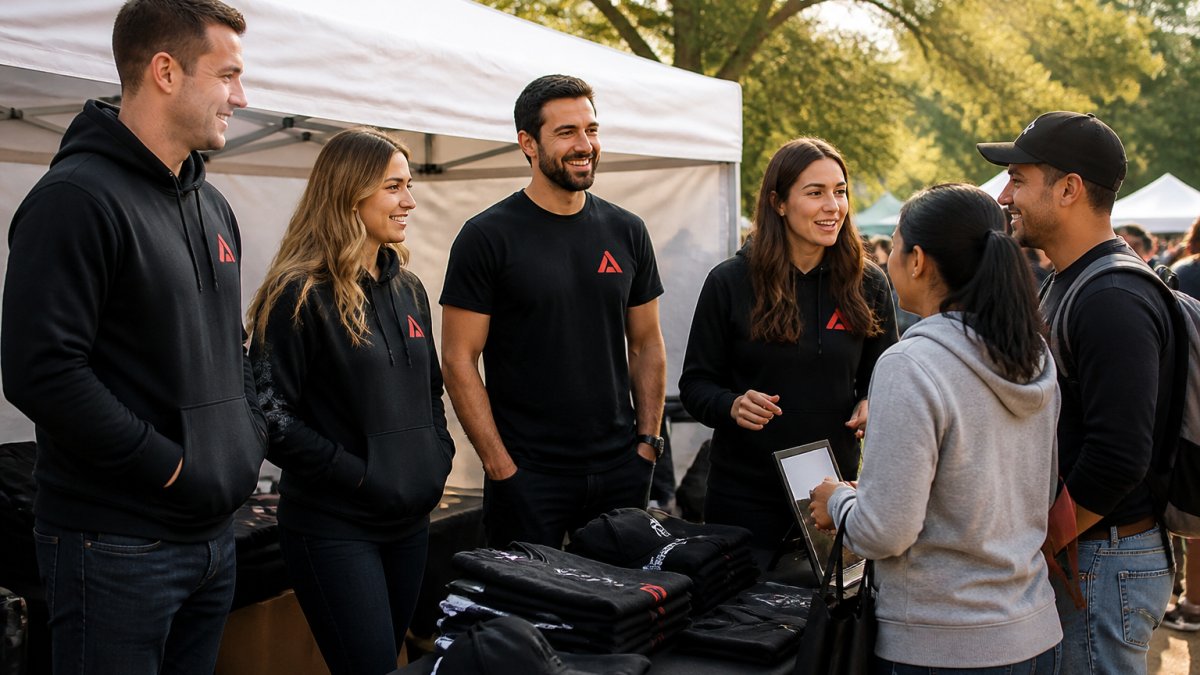
Custom T-shirts and hoodies lead the VistaPrint preference data at 45% and 40%.
Trade show promotional items work best when they double as a walking billboard.
Apparel also solves a problem for service businesses. Banks, car dealers, and construction companies all benefit when staff look consistent and professional.
One caution: cheap blanks fade and peel. The shirt becomes a bad ad.
2. Drinkware: Water Bottles and Coffee Mugs for Daily Brand Visibility
Drinkware wins on repetition. A water bottle or coffee mug sits on a desk five days a week.
VistaPrint reports water bottles at 33% and mugs at 34% in consumer preference. The appeal is simple: both are useful, reusable, and stay in one place.
- Water bottles suit gyms, job sites, and outdoor events
- Coffee mugs fit offices, banks, and dealership waiting rooms
- Both work as thank-you gifts for referral partners
A common mistake is buying the cheapest bottle available. Our bulk promotional water bottles buyer's guide covers ordering details before you commit.
3. Pens and Notebooks: Low-Cost Physical Lead Magnets
Pens and notebooks are the most cost-effective promotional items on this list.
VistaPrint data puts pens at 38%, ahead of mugs, tote bags, and water bottles. That is a strong signal for budget-conscious campaigns.
The lead capture trick is pairing the item with a reason to share contact info. A branded notebook handed out at a seminar invites sign-ups for the slides.
These items also suit high-volume events where you expect hundreds of visitors. Low cost per unit means more chances to start a conversation.
4. Tote Bags: Reusable Giveaways With Staying Power
Tote bags are the workhorse of reusable giveaways. People carry them to farmers markets, conferences, and the beach.
VistaPrint shows tote bags at 34%, level with mugs and ahead of water bottles.
For lead generation, tote bags shine at events with high foot traffic.
Pick a heavier fabric weight and reinforced handles. A flimsy bag tears on the first trip, which is the opposite of staying power.
5. Trade Show Promotional Items: Choosing Giveaways That Capture Contact Info
Trade show promotional items should do two jobs at once: draw people to the booth and collect their details. The best giveaways are the ones people want badly enough to trade an email for.
Market.us reports that 73% of companies use event marketing to generate leads (Lead Generation Statistics and Facts (2026)). That is a crowded floor, so your giveaway has to stand out, and more importantly, it has to be wired to a capture step before the doors open.
Rank your options by capture potential:
| Giveaway | Best For | Capture Method |
|---|---|---|
| Apparel | Booth staff visibility | Scan badge, enter to win |
| Drinkware | High-value prospects | Email for custom order |
| Pens and notebooks | Volume traffic | Sign-up sheet at booth |
| Tote bags | Entrance handout | QR code on the bag |
| Bundled gift set | Qualified meetings | Book a demo on the spot |
How each capture method actually works
A giveaway only becomes a lead when the capture step is concrete. Here is what each method produces and what it costs you in staff time:
- Badge scan. A lead-retrieval scanner reads the attendee badge and logs name, company, title, and email. It is the fastest capture at high traffic and the cleanest for consent because the show's registration terms usually cover it. The trade-off: you get contact data but no qualifying context, so add a one-question verbal screen (budget, timeline, or role) as staff scan.
- QR code to a short form. Print a QR code on the item or the booth sign that opens a mobile form with three to five fields. Keep it short, every extra field cuts completion. Use a form that records the timestamp and the source code so you can tie the lead back to the specific event and giveaway.
- Entry-to-win drawing. A prize drawing pulls volume, but it also pulls prize-seekers. Qualify by asking one screening question at entry and by stating clearly what entrants will receive after the show. A drawing is best for top-of-funnel list building, not for booking meetings.
Qualify at the point of capture
A name and email is not a qualified lead. Add one or two screening questions at capture so your follow-up can be segmented:
- Role or title, decides whether you send a sales email or a nurture sequence.
- Timeline, "researching now" versus "next quarter" changes the follow-up cadence.
- Company size or project scope, routes the lead to the right rep.
Keep the screen to one or two questions. More than that and booth traffic stalls.
Consent and follow-up workflow
Consent matters. If you plan to email people afterward, tell them at the point of sign-up, state what they will receive, and keep a record of when and how they opted in. Clear, honest collection protects your list quality and your reputation, and it keeps you aligned with anti-spam rules that apply to commercial email.
A practical follow-up workflow looks like this:
- Same day: sync scanned badges and form entries into your CRM and tag each lead with the event and the giveaway.
- Within 48 hours: send a short thank-you that references the conversation and delivers whatever you promised (slides, checklist, quote).
- Day 3 to 7: route hot leads to a rep with a call task; put the rest into a nurture sequence.
- Two weeks out: review cost per lead and conversion by giveaway type before you reorder for the next show.
Lead Capture Strategies That Turn Giveaways Into Leads
Lead capture strategies decide whether a giveaway becomes a lead or just a freebie. The product gets attention. The capture step gets the contact.
Use these tactics at every campaign:
- Scan badges at trade shows and log consent at the booth
- Offer a QR code that opens a short form on a phone
- Run an entry-to-win drawing with a clear prize
Consent matters. If you plan to email people afterward, tell them at the point of sign-up and keep a record.
Personalization and accessibility are two angles most campaigns skip. Offer plus sizes in apparel. Choose items that work for people with limited grip or mobility.
Lead Generation Giveaways: Measuring Cost Per Lead and Campaign ROI
Measuring lead generation giveaways comes down to two numbers: cost per lead and return on investment. If you cannot calculate them, you cannot tell a good campaign from an expensive one.
Start with total campaign cost. Our promotional items budget planning tips help you forecast and control campaign costs. Add product cost, decoration, shipping, and booth fees.
Cost per lead = total campaign cost ÷ qualified leads
ROI = (revenue from campaign − campaign cost) ÷ campaign cost
For example, a campaign that costs $2,000 and produces 40 qualified leads lands at $50 per lead.
Build the full cost stack before you compare products
Most cost-per-lead mistakes come from counting only the unit price. A realistic budget includes:
- Product cost, the per-unit price at your order quantity.
- Decoration and setup, screen or embroidery setup charges, plus per-piece run charges.
- Shipping and freight, especially for heavy items like drinkware and apparel.
Add these up before you divide. A pen that looks cheap per unit can carry a higher cost per qualified lead than a bottle if the pen campaign produces mostly unqualified traffic.
Compare products on cost per qualified lead
Use a simple worksheet to compare candidates side by side. For each product, record:
- Total campaign cost (the full stack above).
- Number of contacts captured.
- Number of those contacts that meet your qualification criteria.
- Cost per qualified lead = total cost ÷ qualified leads.
- Conversion rate = closed deals ÷ qualified leads.
- Revenue and profit from closed deals.
Rank products by cost per qualified lead, not cost per unit. The item with the best unit price often loses once distribution and follow-up costs are included, because low-value giveaways attract volume that never qualifies.
Set a target before you order
Decide the maximum cost per qualified lead your business can absorb, based on your average deal value and close rate. If your average sale is $1,200 and you close roughly one in four qualified leads, your allowable cost per lead is a fraction of that deal value, set the ceiling first, then choose the product that fits inside it.
Track the metrics that matter. HubSpot reports that marketers rank lead quality and marketing-qualified leads (39%), lead-to-customer conversion rate (34%), and return on investment (31%) among their top metrics in 2026.
Frequently Asked Questions
Which promotional products are best for generating leads?
The strongest lead-generating promotional products are useful items people keep and use daily: custom T-shirts and hoodies, drinkware like water bottles and coffee mugs, pens and notebooks, and reusable tote bags. VistaPrint reports that 45% of respondents selected T-shirts, 40% hoodies, 38% pens, 34% mugs, 34% tote bags, and 33% water bottles. Pair each item with a clear lead capture strategy, such as a QR code or sign-up form, so the giveaway produces contact information you can follow up on.
How can businesses use giveaways to collect leads?
Use giveaways as physical lead magnets tied to a simple exchange. Ask attendees to complete a short form, scan a QR code, or drop a business card before receiving the item. Train staff to explain the offer and qualify interest with one or two questions. Then route the captured data into your CRM within 24 hours and send a follow-up email. This approach turns a freebie into a measurable lead generation giveaways program rather than a giveaway with no tracking.
How do you measure leads generated by promotional products?
Start by assigning a unique code, QR link, or landing page to each promotional campaign so you can trace responses back to the item. Track the number of leads captured, cost per lead, and lead-to-customer conversion rate over time. HubSpot reports that 39% of marketers say lead quality and marketing-qualified leads matter most in 2026, followed by conversion rate at 34% and ROI at 31%. Compare those metrics against campaign cost to see which products earn repeat investment.
What should you include with a branded giveaway at an event?
Pair the item with a clear call to action: a QR code linking to a sign-up page, a short survey, or a scheduled demo. Include your logo, website, and a brief line about what you do. At trade shows, use trade show promotional items that match your audience, such as notebooks for construction companies or drinkware for dealerships. Keep the form short, explain how you will use contact data, and follow up within a few days while the event is still fresh.