 blog
How to Choose Custom Apparel for Restaurant Staff
Last Updated: October 25, 2026
Quick Summary
The best restaurant staff apparel splits along the front-of-house and back-of-house line: front of house needs polish and guest-facing comfort, while back of house needs heat tolerance, stain resistance, and safety. Match each role to the right garment, fabric, and personalization method, since buying one uniform for everyone usually fails both groups.
- Front-of-house server shirts and polos should be breathable cotton-poly blends that hold their shape through a double shift.
- Kitchen staff need chef coats in heavyweight cotton blends plus slip-resistant footwear with grip and closed toes.
- Embroidery is the default for polos, chef coats, and aprons because it survives industrial laundering better than printed transfers.
- Estimate cost per wear rather than sticker price, since a cheap shirt that fades after 30 washes can cost more.
- Budget 10-15% of the initial order value annually for replacements and additions.
Table of Contents
- Why Custom Restaurant Uniforms Matter for Team Identity
- Restaurant Staff Uniform Ideas by Role: Front of House vs. Back of House
- Restaurant Work Shirts: Choosing Fabric, Fit, and Breathability
- Chef Coats with Logo: Embroidery, Placement, and Durability
- Custom Restaurant Aprons: Practical Uses and Material Choices
- Embroidery vs. Printing: Personalization Methods Compared
- Budgeting, Sizing, and Care for Your Uniform Program
- Get a Quote on Custom Restaurant Staff Apparel
- Frequently Asked Questions
Why Custom Restaurant Uniforms Matter for Team Identity
Custom restaurant uniforms are branded garments worn by staff that tie a restaurant's team appearance to its brand identity.
The uniform does quiet work. It tells guests who to ask for a table, who is carrying food, and who is running the kitchen. It also tells your team that they belong to something specific rather than just filling a shift.
Watch out: the most common mistake we see is treating uniforms as an afterthought ordered two weeks before opening. Cheap blanks with a peeling logo undo the brand identity you spent months building.
If you're still mapping out the full design process, our guide on how to design professional uniforms walks through it step by step.
Restaurant Staff Uniform Ideas by Role: Front of House vs. Back of House
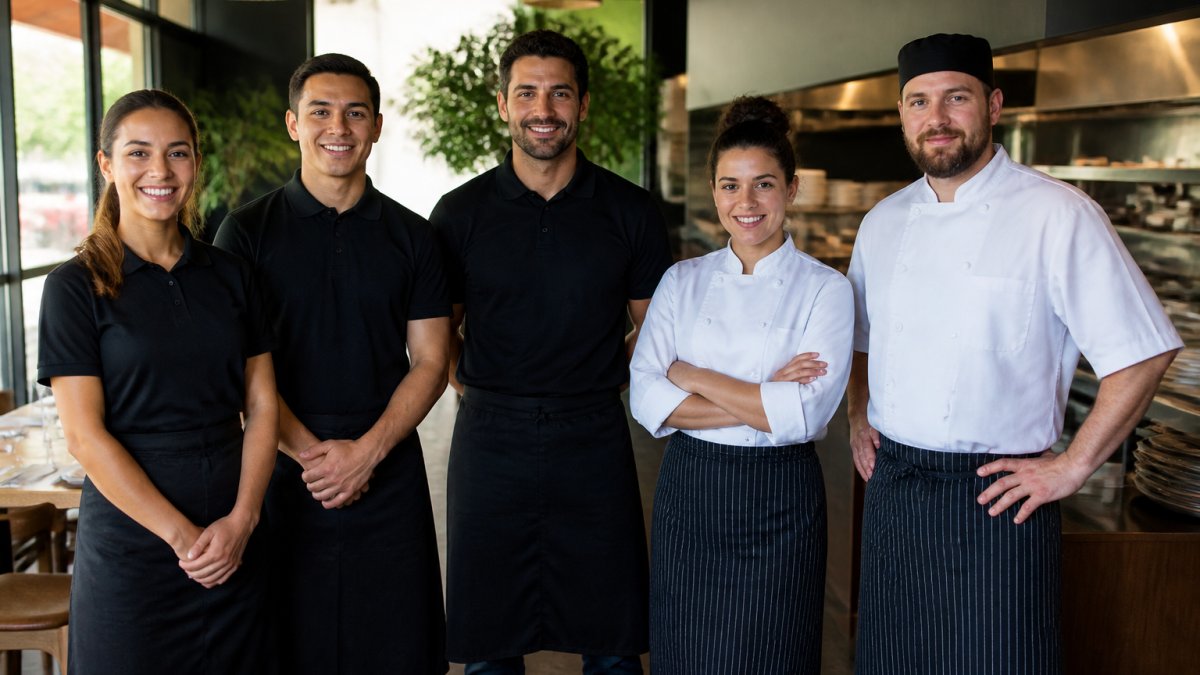
The best restaurant staff apparel splits cleanly along the front-of-house and back-of-house line. Front of house needs polish and guest-facing comfort. Back of house needs heat tolerance, stain resistance, and safety. Buying one uniform for everyone usually fails both groups.
Think of your restaurant concept as the filter. Fast casual and quick-service restaurants lean toward durable tees and aprons. Fine dining calls for structured shirts and tailored aprons. The dress code follows from there.
Front-of-House Apparel: Server Shirts, Polos, and Work Shoes
Server shirts and server polos form the first impression, so fit and fabric matter more than decoration. A well-cut polo in a breathable cotton-poly blend holds its shape through a double shift. Custom T-shirts work for casual concepts but read as underdressed in fine dining. For hosts and hostesses, a branded button-down or a crisp polo in a lighter color signals the greeting role without competing with servers.
Footwear deserves equal attention. Slip-resistant footwear protects servers on wet floors and reduces the falls that plague busy dining rooms. Many operators find that a single approved shoe style keeps the look consistent and simplifies replacement. Look for shoes with closed toes, oil-resistant soles, and a defined heel; these are common requirements in food-service settings and reduce slip risk during a rush.
Back-of-House Apparel: Chef Coats, Kitchen Shirts, and Slip-Resistant Footwear
Kitchen staff need garments that survive heat, grease, and constant washing. Chef coats in a heavyweight cotton blend protect arms from splashes while keeping the line looking sharp. For line cooks who move constantly, short-sleeve chef coats or kitchen shirts with mesh panels improve airflow without sacrificing protection.
Slip-resistant footwear matters just as much in the kitchen, where spills and steam make floors treacherous. A common mistake is buying kitchen shoes for looks; prioritize grip and closed toes instead. Many kitchens also require non-slip clogs or shoes that can be wiped clean at the end of a shift, which helps with hygiene and reduces the time staff spend cleaning footwear.
For a deeper comparison of materials, our guide to the best fabrics for custom printing breaks down how each one performs over time.
Restaurant Work Shirts: Choosing Fabric, Fit, and Breathability
Fabric choice decides whether restaurant work shirts get worn or left in a locker. Breathable fabrics like cotton-polyester blends move moisture and dry fast, which matters during a rush. Pure cotton breathes well but wrinkles and stains more readily. Polyester holds color and resists stains but can trap heat.
Fit and ease of movement come next. A shirt that binds at the shoulder slows a server carrying a tray. Look for gusseted underarms and a cut that allows a full range of motion.
For a deeper comparison of materials, our guide to the best fabrics for custom printing breaks down how each one performs over time.
Chef Coats with Logo: Embroidery, Placement, and Durability
Chef coats with logo embroidery strike the right balance of professionalism and durability. Embroidery survives repeated industrial laundering far better than printed transfers, which tend to crack and fade. Placement matters: the left chest is the standard, while a sleeve or collar mark adds a subtle second touch.
Durability depends on stitch density and backing. A dense, well-backed logo holds up through hot washes and heavy use. A thin, rushed stitch job will fray within months.
Watch out: placing a large logo across the back of a chef coat looks busy and can interfere with the garment's drape. Keep it clean and deliberate.
Our article on best practices for logo placement covers the placement rules in more detail.
Custom Restaurant Aprons: Practical Uses and Material Choices
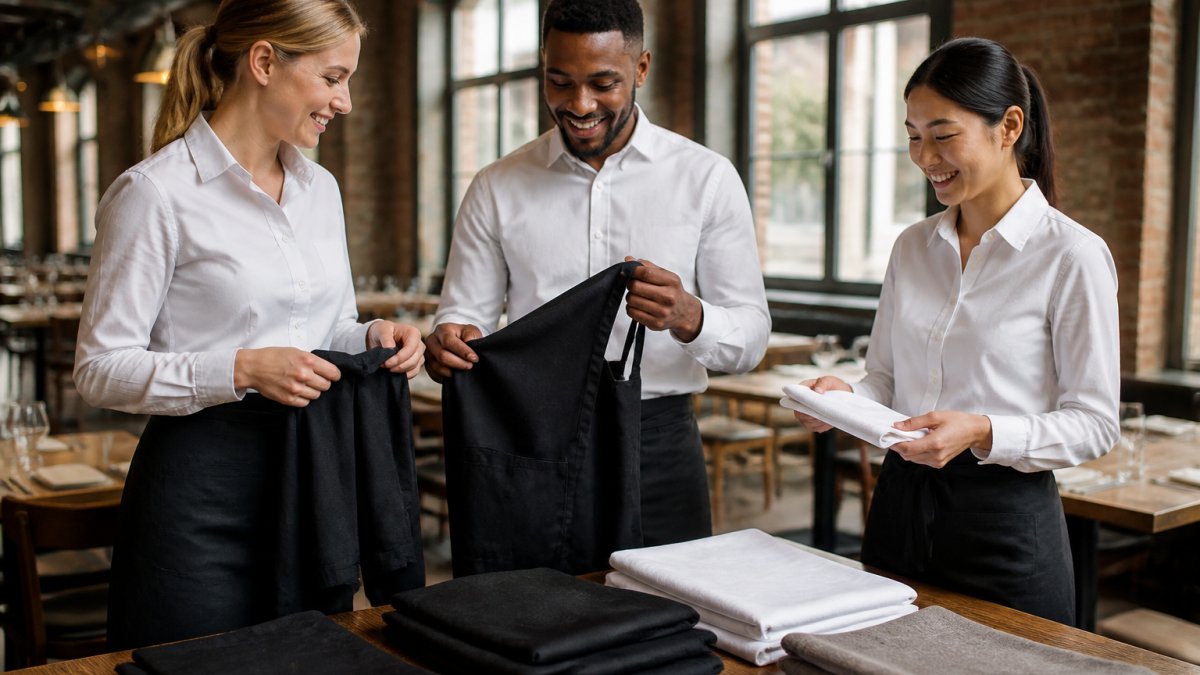
Custom restaurant aprons do two jobs: they protect clothing and they carry your logo at the guest's eye level. Servers use bib aprons for carrying order pads and pens, while bartenders often prefer waist aprons for speed. Kitchen staff need heavier canvas that resists grease and heat.
Material choice follows the role. Canvas and denim hold up to heavy use and repeated washing, while lighter cotton-poly blends suit front-of-house staff who want a cleaner look. Adjustable ties and reinforced pockets extend the life of an apron considerably.
Embroidery vs. Printing: Personalization Methods Compared
Embroidery and printing each suit different garments and budgets. Embroidery gives a textured, premium finish that lasts, making it the default for polos, chef coats, and aprons. Printing delivers sharp, multi-color designs and works well on custom T-shirts and event apparel.
The trade-off is cost and lead time. Embroidery setup involves digitizing your logo once, then the per-piece cost stays stable. Printing can be cheaper at volume but may not survive as many wash cycles.
| Method | Best For | Durability | Look |
|---|---|---|---|
| Embroidery | Polos, chef coats, aprons | High, survives industrial washing | Textured, premium |
| Screen printing | Custom T-shirts, event apparel | Moderate, can crack over time | Bold, multi-color |
| Heat transfer | Small runs, names | Lower, fades faster | Flat, budget-friendly |
For a closer look at whether the investment pays off, read is custom embroidery worth it for work shirts.
Budgeting, Sizing, and Care for Your Uniform Program
A uniform program is a running cost, not a one-time purchase. Budget for initial orders plus replacement and laundering. Build in a buffer of extra sizes for new hires and damage, and confirm minimum order quantities and shipping time before you commit to a launch date.
Total Cost of Ownership and Budget Planning
Most operators underestimate the total cost of ownership because they focus on the per-piece price. A more useful approach is to estimate cost per wear: divide the garment cost by the number of shifts it will realistically survive. A cheaper shirt that fades after 30 washes can cost more per wear than a durable polo that lasts 100 washes. Factor in customization fees (embroidery digitizing is usually a one-time setup, while screen printing may have per-color setup), minimum order quantities, and replacement frequency. Laundering also adds up: if you use a commercial service, get a per-pound or per-piece quote; if staff launder at home, specify care instructions that do not require special treatment. A common pattern is to budget 10-15% of the initial order value annually for replacements and additions, though the right figure depends on turnover and garment quality.
Sizing, Inclusive Fits, and Ordering Quantities
Sizing is where programs quietly fail. Collect measurements from every team member rather than assuming standard sizes, and offer inclusive fits so everyone has a garment that looks and feels right. When planning quantities, order a size run that matches your actual staff distribution, plus a small buffer of the most common sizes (typically medium and large) for new hires. For embroidered items, confirm whether the vendor allows adding a name or logo to a blank later; this can reduce the need to over-order customized pieces. Also ask about size exchanges and whether there is a restocking fee.
Care, Laundering, and Replacement Planning
Set a simple care routine: wash according to the garment's label, avoid high heat on embroidered pieces, and inspect aprons and coats for wear each quarter. Embroidery generally tolerates industrial washing better than heat transfers, but high heat can still degrade thread and backing over time. Turn garments inside out before washing to protect the logo, and avoid fabric softener on moisture-wicking fabrics because it can clog the fibers. For replacement planning, track which roles wear out garments fastest (often back-of-house due to grease and heat) and set a replacement trigger, such as visible staining, frayed seams, or faded logos. Keeping a small reserve of unisex aprons and chef coats in common sizes can bridge the gap between order cycles.
For a full cost breakdown, see our guide on budgeting for branded employee apparel.
Get a Quote on Custom Restaurant Staff Apparel
Choosing the best custom apparel for restaurant staff comes down to matching each role to the right garment, fabric, and personalization method. Get that right and your team looks sharp, stays comfortable, and reinforces your brand with every shift.
Logo Concepts & Printing handles the whole program: in-house graphic design, embroidery and screen printing, and rapid turnaround so your launch stays on schedule. We work with businesses of every size, from automotive dealerships to investment firms.
Contact us today for a quote and let our team build a uniform program that fits your concept and your budget.
Frequently Asked Questions
What fabrics are best for restaurant uniforms?
Breathable cotton blends and performance polyester work best for restaurant staff apparel. Cotton breathes well in hot kitchens but wrinkles and stains easily; polyester resists stains and holds color through repeated washing. A 60/40 cotton-poly blend balances comfort and durability. Look for stain-resistant finishes and reinforced stitching at stress points. For aprons, heavier canvas or twill protects against spills, while lightweight blends suit front-of-house staff who need ease of movement.
Are embroidered or printed logos better for restaurant uniforms?
Embroidery suits chef coats, polos, and aprons because it holds up to industrial laundering and gives a professional look. Printed logos work better on performance fabrics and stretchy materials where embroidery could pucker. For high-turnover staff, embroidery on the left chest is standard and durable. If you need full-color graphics or gradients, printing is the better choice. Many restaurants use embroidery for permanent staff and printing for event or seasonal apparel.
How many uniforms should restaurant employees have?
Plan for at least three sets per employee: one worn, one clean, one in the wash. Back-of-house staff often need more due to grease and heat exposure, so four sets is common. Factor in replacement planning since aprons and chef coats wear faster than polos. Ordering extras in common sizes reduces reorder costs and keeps your team looking consistent during busy seasons.
How do I choose restaurant staff apparel that is comfortable and easy to maintain?
Prioritize breathable fabrics, ease of movement, and stain resistance. Server shirts should allow reaching and carrying without riding up; chef coats need ventilation and heat tolerance. Check care labels: uniform programs work best when garments tolerate commercial laundering and color retention. Sizing inclusivity matters too, so offer a range of fits and order based on actual measurements rather than guesswork. Always request a sample before placing a full order.