 blog
blog
Is Custom Embroidery Worth It for Work Shirts?
Table of Contents
- The Real Value of Custom Embroidery for Work Shirts
- Embroidery vs Screen Printing for Uniforms: Which Wins?
- Cost of Custom Embroidery Per Shirt: Breaking Down the Numbers
- Durability of Embroidered Logos: What to Expect
- Industries and Jobs Where Embroidery Makes Sense
- When Embroidery Isn't the Right Choice
- Getting Your Embroidery Right: Design and Approval
- Frequently Asked Questions
Last Updated: October 7, 2026
The Real Value of Custom Embroidery for Work Shirts
When you're deciding whether custom embroidery is worth it for work shirts, you're really asking: does the investment pay off in durability, professional impact, and long-term value?
Custom embroidery creates a polished, permanent brand presence. Unlike screen printing, which fades or cracks with repeated washing, embroidered logos use thread stitched directly into the fabric.
What matters is matching the method to your needs.
Here's what you need to know to make the right call.
Embroidery vs Screen Printing for Uniforms: Which Wins?
Custom embroidery and screen printing solve different problems. Embroidery excels at durability and polish; screen printing at speed and affordability for large orders. The "winner" depends on what matters most to your team.
Durability and Longevity Comparison
Embroidered logos hold up to industrial washing, repeated wear, and years of use.
Screen printing uses ink applied to the surface. With frequent hot-water washing, the ink breaks down: edges crack and colors fade. After 50 to 100 washes, many screen-printed logos show visible wear.
For uniforms worn daily, embroidery wins on longevity. For seasonal merchandise or short-term campaigns, screen printing is often sufficient and more economical.
Aesthetic and Professional Impact
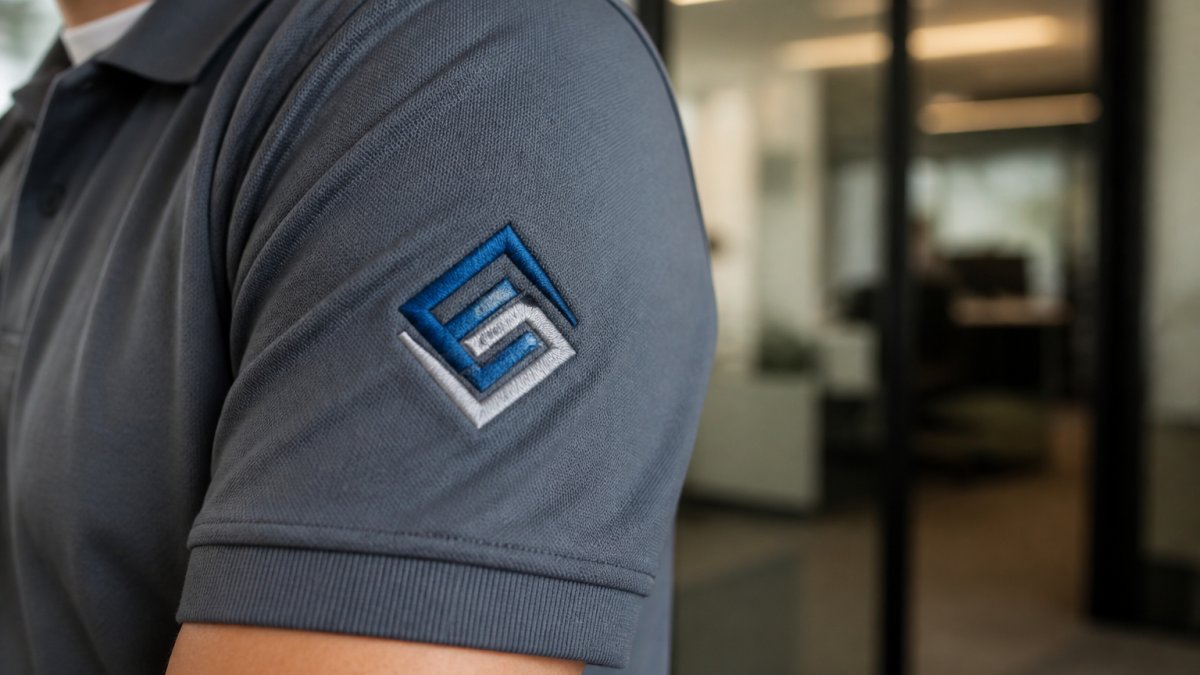
Embroidery creates a three-dimensional texture that reads as premium and intentional. Professional services, financial institutions, law firms, and automotive dealerships choose it specifically because it conveys quality and permanence.
Screen printing lies flat against the fabric. It can look crisp and modern with bold, simple designs, but it lacks embroidery's tactile presence. If your brand depends on a polished, high-touch appearance, embroidery signals that investment more effectively.
Setup Costs and Order Minimums
Screen printing typically has lower setup costs and lower per-unit pricing on large orders.
Order minimums are lower than they used to be. Many vendors work with smaller quantities than the industry standard of 25 or 50 units.
For orders under 25 units, embroidery can feel expensive per shirt. For orders over 50 units, the per-unit cost drops enough that embroidery becomes competitive with screen printing.
Cost of Custom Embroidery Per Shirt: Breaking Down the Numbers
The total cost of an embroidered work shirt program comes down to five variables: order quantity, logo size and stitch count, digitizing and setup fees, garment quality, and replacement frequency. Most buyers only look at the first invoice, which is why embroidery can feel expensive. The number that matters is cost per wear.
How Quantity Affects Per-Unit Pricing
Embroidery pricing has two parts: a one-time setup fee and a per-unit run charge. The setup fee doesn't shrink with quantity, but it gets spread across more shirts, which is why quantity changes the math.
A simple way to see it: if your setup fee is $75 and your per-unit run charge is $8, then 12 shirts cost ($75 + $96) ÷ 12 = about $14.25 per shirt in decoration cost alone.
Embroidery typically becomes cost-competitive with screen printing somewhere between 50 and 100 units, depending on logo complexity and garment choice. Below 25 units, the setup fee dominates and embroidery looks expensive per shirt. Judge it on cost per wear, not cost per unit.
Setup Fees, Thread, and Hidden Costs
Setup fees cover digitizing, the process of converting your logo into a stitch file the embroidery machine can read. This is a one-time cost per design. If you reorder the same design in six months, you shouldn't pay it again. Ask your vendor to confirm that the digitized file is stored for future orders.
Several factors push the per-unit price up:
- Stitch count. A simple left-chest wordmark might run 4,000 to 6,000 stitches; a detailed crest with small text and multiple colors can run 10,000 to 15,000 or more. More stitches means more machine time and a higher run charge.
- Color changes. Each thread color change adds machine time, so a three-color logo costs more to run than a one-color logo of the same size.
- Logo size. A 3-inch chest logo and a 10-inch back logo are not the same job; back logos can triple the stitch count.
A Transparent Break-Even Example
Here is an illustrative example with stated assumptions. Your actual quote will vary by vendor, region, and design.
Assumptions:
- Left-chest logo, one color, roughly 5,000 stitches
- Setup/digitizing fee: $75 (one time)
- Per-unit embroidery run charge: $7
| Quantity | Embroidered total | Embroidered per shirt | Screen-printed per shirt |
|---|---|---|---|
| 12 | $375 | $31.25 | $29.08 |
| 50 | $1,325 | $26.50 | $22.50 |
| 100 | $2,575 | $25.75 | $22.00 |
| 250 | $6,325 | $25.30 | $21.90 |
At first glance, screen printing wins on price at every quantity. Now apply cost per wear.
If the screen-printed logo cracks and fades after roughly 50 to 100 industrial washes and the shirt gets pulled from rotation, while the embroidered logo stays intact for the life of the garment, embroidery delivers more wears per dollar.
What Actually Drives the Total Uniform Program Cost
Cost per shirt is only one line in the budget. A realistic uniform program also includes:
- Replacement rate. If you replace 20% of shirts per year with screen printing and 8% with embroidery, the annual spend gap narrows fast.
- Reorder setup fees. Confirm whether reorders trigger a new setup fee; reputable vendors waive it when the file is unchanged.
- Name personalization. Adding individual names is a separate setup per name in some shops and a per-unit charge in others. Ask before you assume.
When you add those lines together, embroidery often wins on total program cost for any team that wears the same shirt more than a few times a week. For one-off events or short campaigns, it rarely does.
Durability of Embroidered Logos: What to Expect
Embroidered logos are built to outlast the garment in most cases, but 'durable' is not a single number. It depends on stitch quality, backing, thread type, fabric, and laundering. Here's what happens over time and how to compare it honestly against a printed logo.
How Embroidered Logos Hold Up to Washing
A well-digitized embroidered logo on a stable fabric typically survives hundreds of home or commercial wash cycles without visible degradation. The thread is stitched through the fabric, so there's no surface layer to crack, peel, or flake off, and color fading is minimal because the thread is dyed through.
What does fail, and when:
- Loose or broken stitches (30 to 50 washes). Usually caused by poor digitizing, insufficient backing, or a needle punching through the same hole repeatedly, making the design look fuzzy at the edges.
- Puckering (first wash onward). The fabric pulls around dense stitching, especially on lightweight or stretchy garments. This is a fabric-and-design mismatch, not a wear issue.
- Thread breaks at tight corners (months 3 to 6). Fine detail and sharp angles concentrate tension; a good digitizer compensates, a bad one doesn't.
Laundering and Care Guidance That Actually Matters
Most embroidered work shirts fail because of how they are washed, not because the embroidery was bad.
- Turn the shirt inside out before washing to reduce abrasion from other garments.
- Wash cold or warm, not hot. Heat is the enemy of both thread and backing.
- Skip fabric softener. It leaves a residue that dulls thread and attracts lint.
Fabric Type and Stitching Quality Matter
Embroidery behaves differently depending on what it is stitched into.
| Fabric | Embroidery behavior | Notes |
|---|---|---|
| Medium-weight cotton and cotton blends | Excellent | The default for work shirts; holds shape and backing well |
| Poly-cotton twill | Excellent | Common in uniform programs; resists shrinking |
| Performance and moisture-wicking knits | Good with the right backing | Needs a cut-away or no-show backing to avoid stiffness |
| Lightweight jersey (under about 4.5 oz) | Fair | Prone to puckering; keep logos small and stitch counts low |
| Stretch and spandex blends | Fair to poor | Design can distort as the fabric moves; needs stabilizer |
| Heavy canvas and denim | Good | Requires heavier needles and thread; slower production |
Stitching quality is the single biggest variable. High-quality digitizing distributes thread tension evenly; poor digitizing creates tight spots where thread breaks or unravels. When you evaluate an embroiderer, ask three questions: Do you test-stitch every new design before production? What backing do you use for this fabric?
Comfort, Weight, and Heat
Dense embroidery adds weight and stiffness, which matters for anyone wearing a shirt for a full shift.
- A typical left-chest logo adds negligible weight and isn't noticeable.
- A large back logo with 15,000+ stitches can feel stiff and heavy, especially on a lightweight shirt.
- On hot-weather workwear, a dense chest logo can trap heat and reduce breathability. For outdoor or kitchen environments, keep logos smaller and use a lighter backing.
If comfort is a top concern, request a wear test: have one employee wear the sample shirt for a full shift before you approve the full order.
Embroidery vs Printed Logos: A Realistic Durability Comparison
| Factor | Embroidery | Screen print | Heat transfer / DTG |
|---|---|---|---|
| Typical visible wear point | 100+ washes (quality dependent) | 50 to 100 washes | 20 to 50 washes |
| Failure mode | Loose stitches, thread breaks | Cracking, fading, peeling edges | Cracking, peeling, color shift |
| Color fade | Minimal | Moderate to significant | Significant |
| Feel on garment | Raised, textured | Flat, thin | Flat, can feel rubbery |
| Best for | Long-life uniforms | Large runs, short campaigns | Small runs, complex art |
| Worst for | Fine detail, gradients, photos | Long-life daily-wear uniforms | Repeated industrial washing |
Industries and Jobs Where Embroidery Makes Sense
Embroidery is the right choice for uniforms that need to last and represent a professional brand consistently.
Construction and trades: Workers wear the same shirt for months.
Automotive dealerships: Sales and service staff wear uniforms that represent the business to customers daily. Embroidered logos convey quality and permanence.
Financial services and banking: Professional appearance matters.
Community banks and credit unions: Local financial institutions often use embroidered apparel as part of their brand identity; the polish of embroidery aligns with how they present themselves.
Healthcare and professional offices: Medical practices, dental offices, and professional services use embroidered scrubs and jackets, where permanence keeps logos crisp for the life of the garment.
When Embroidery Isn't the Right Choice
Embroidery is expensive upfront and slower than screen printing. It's not the answer for every situation.
Very small orders: Ordering five embroidered shirts divides the setup fee across just five units, making the per-shirt cost high.
Complex, detailed artwork: Embroidery works with logos and simple designs. Photographs, gradients, and fine detail don't translate well to thread.
Budget-conscious orders: When cost per unit is the primary concern and durability is secondary, screen printing wins.
Getting Your Embroidery Right: Design and Approval
The difference between embroidery that looks professional and embroidery that looks cheap often comes down to design choices and approval process.
Start with a logo that works at small scale.
Work with your embroiderer to test the design on a sample garment before committing to a full order. This catches thread color mismatches, stitch density issues, and placement errors before production.
Placement matters.
The real question isn't whether is custom embroidery worth it for work shirts in general.
When you're ready to explore custom embroidery for your team, contact Logo Concepts & Printing today.
Frequently Asked Questions
How much does a custom embroidered shirt cost compared to screen printing?
Custom embroidery typically costs more per shirt than screen printing, especially for small orders. Embroidery has higher setup fees and slower production per unit. However, embroidered logos last significantly longer through repeated washing and industrial laundering, making the cost per wear lower over time. For orders under 50 units, screen printing is usually cheaper upfront. For uniforms worn daily over 2+ years, embroidery's durability often justifies the higher initial investment. Exact pricing depends on quantity, design complexity, and shirt material, request a quote to compare.
What are the primary downsides of using embroidery for work shirts?
The main drawbacks are higher upfront costs, longer production timelines, and setup fees that don't scale well for small orders. Complex designs with fine detail don't work well in embroidery, they become muddy or require excessive stitch count, driving costs up. Embroidered logos can create a slightly raised, textured finish that some find less sleek than screen printing. Very small logos (under 1 inch) are difficult to embroider cleanly. If you need shirts quickly or have a tight budget for small quantities, screen printing is usually the better choice.
Is embroidery more durable than screen printing for daily wear?
Yes, embroidered logos significantly outlast screen-printed designs on work shirts exposed to frequent washing and physical wear. Embroidery uses thread stitched directly into the fabric, so logos remain intact through industrial laundering and high-temperature washing. Screen printing sits on the surface and gradually fades, cracks, or peels after 30-50 washes. For work uniforms worn multiple times per week, embroidery maintains a professional appearance for 2-3 years or longer. For occasional-wear apparel or events, screen printing's shorter lifespan may be acceptable.
What types of fabrics are best suited for custom embroidery on work shirts?
Denser, more stable fabrics work best for embroidery: cotton twill, cotton canvas, and heavyweight cotton blends. These fabrics support the stitching without puckering or distorting. Lightweight, stretchy fabrics like thin polyester or spandex blends are difficult to embroider cleanly because the needle movement causes fabric distortion. Performance fabrics designed for sweat-wicking may be too delicate. When selecting a shirt for embroidery, choose a weight and weave that feels substantial, your supplier can confirm suitability. The right fabric choice prevents puckering and ensures your embroidered logo looks crisp.