 ultimate-guide
Custom Apparel Printing for Small Businesses: 2026 Guide
Table of Contents
- Custom Apparel Printing for Small Businesses: What Changes in 2026
- Best Custom Apparel Printing Methods for Brand Goals
- Screen Printing vs Embroidery for Business: Which Wins on Cost and Durability
- How to Design Company Shirts That People Actually Wear
- Bulk Pricing, No Minimums, and Rush Delivery: Ordering Without Surprises
- Fabric Weight, Washability, and Choosing the Right Garment
- The ROI of Custom Apparel for Small Businesses
- Sustainable Sourcing and Inventory Management for Merch
- Frequently Asked Questions
Last Updated: September 15, 2026
Custom Apparel Printing for Small Businesses: What Changes in 2026
Custom apparel printing for small businesses is the process of decorating garments with your brand's logo or message, and in 2026 the biggest shift is that you no longer need a warehouse full of inventory to look established. At Logo Concepts & Printing, we've spent over 25 years in the industry, observing shifts in order sizes and design expectations. This combination influences which printing method best suits a ten-person team.
The old rule was simple: screen printing for volume, everything else for small runs. That rule is now too blunt. Digital printing and heat transfer have closed the quality gap on short runs, and embroidery has become the default for anything a customer sees up close. Below, we break down which method fits which brand goal, what drives your cost per unit, and how to order without minimums getting in the way.
Quick Comparison: Printing Methods at a Glance
| Method | Best For | Setup Cost | Durability |
|---|---|---|---|
| Screen printing | 24+ units, 1-3 colors | Higher | Excellent |
| Digital printing | Small runs, full color | None | Good |
| Embroidery | Polos, hats, uniforms | One-time digitizing | Excellent |
| Heat transfer | Names, numbers, rush jobs | None | Moderate |
Best Custom Apparel Printing Methods for Brand Goals
The best custom apparel printing method depends on three variables: order quantity, color count, and how the garment will be worn. A trade services company ordering workwear has different needs than a nonprofit ordering event shirts for a single weekend.
Screen Printing vs. Digital Printing
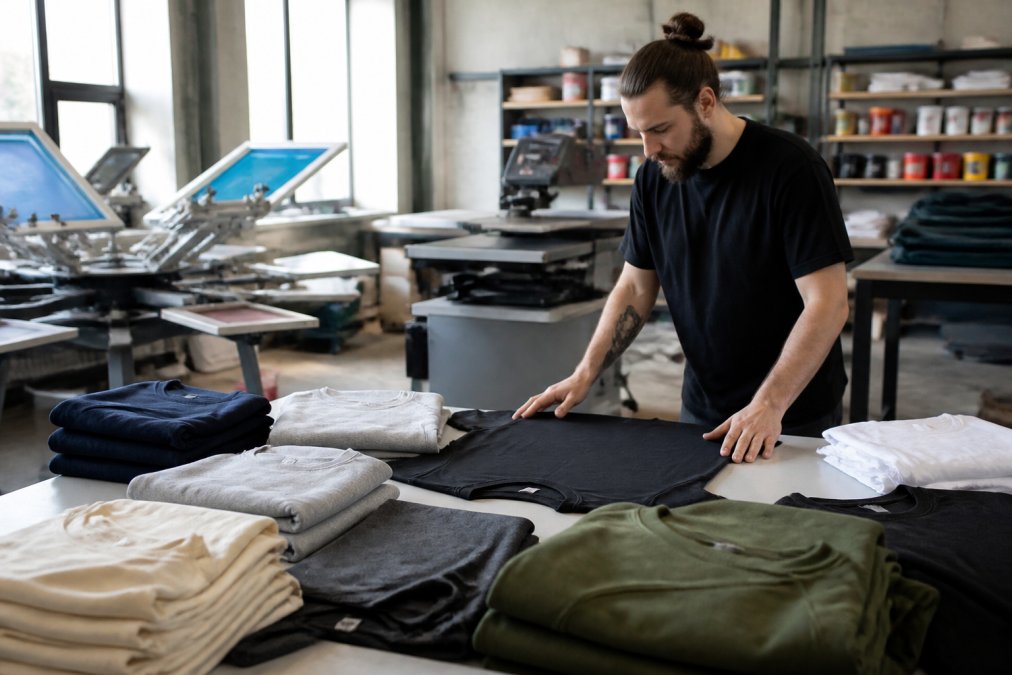
Screen printing pushes ink through a mesh screen, one screen per color. It's the most cost-effective option once you cross roughly two dozen units, and the ink sits on the fabric rather than soaking in, which keeps colors vivid through repeated washing. The catch is setup: each color needs its own screen, so a four-color design on twelve shirts carries setup costs that never amortize.
Digital printing, often called direct-to-garment, prints straight onto the fabric like a large inkjet printer. There's no setup fee and no color limit, which makes it the right call for small runs, photographic designs, and gradients that screens can't reproduce cleanly. Per-unit cost stays flat whether you order 6 shirts or 60.
Printful's guide to direct-to-garment printing explains how DTG ink bonds with cotton fibers, which is useful background if you're comparing fabric options.
Embroidery vs. Heat Transfer
Embroidery stitches thread directly into the garment and is the standard for polos, hats, jackets, and anything worn in front of customers. The one-time cost is digitizing your logo into a stitch file, which you pay once and reuse forever. After that, per-unit pricing is predictable and the decoration outlasts the garment itself.
Heat transfer applies a printed film or vinyl to the fabric with heat and pressure. It's fast, handles complex multi-color artwork without setup, and works on performance fabrics that embroidery can't pierce cleanly. The tradeoff is longevity: lower-grade transfers crack and peel after repeated washing, so ask your vendor which transfer grade they use before committing to a large order.
Screen Printing vs Embroidery for Business: Which Wins on Cost and Durability
Embroidery wins on durability for garments worn regularly; screen printing wins on cost per unit for large runs of simple designs. That's the short answer. The longer answer depends on how your team actually wears the apparel.
For staff apparel and uniforms, embroidery is almost always the better investment. A stitched logo survives industrial laundering, doesn't fade, and reads as professional on a polo or work shirt. Screen printing on a uniform that gets washed twice a week will show wear within a season.
For event merchandise and giveaway shirts, screen printing is the practical choice. You're optimizing for cost per unit across a large quantity, and the garment itself has a shorter lifespan by design.
| Factor | Screen Printing | Embroidery |
|---|---|---|
| Ideal quantity | 24+ units | 6+ units |
| Color limits | One screen per color | Up to 15 thread colors |
| Per-unit cost at 100 units | Lowest | Moderate |
| Washability | 50+ washes | Outlasts garment |
| Best garment | T-shirts, hoodies | Polos, hats, jackets |
How to Design Company Shirts That People Actually Wear
The single biggest mistake small businesses make is treating a company shirt like a billboard. Shirts that get worn outside work are the ones that look like something the person would have bought anyway. For effective branding, your logo should be present, not dominant.
Three general design rules:
- Keep the front clean. One logo, placed on the left chest, sized so it reads from a few feet away. A left-chest logo roughly 3 to 4 inches wide is the standard for polos and tees.
- Put the detail on the back. Larger graphics, taglines, or event dates belong on the back where there's room to breathe.
- Match the garment to the setting. A heavyweight tee for a trade crew, a performance polo for client-facing staff, a hoodie for casual culture.
Vector Artwork and Color Matching Basics
Vector artwork is a logo built from mathematical paths rather than pixels, which means it scales to any size without blurring. If your only logo file is a JPG or PNG pulled from a website, your printer will need to redraw it, and that redraw is where most logo placement errors originate.
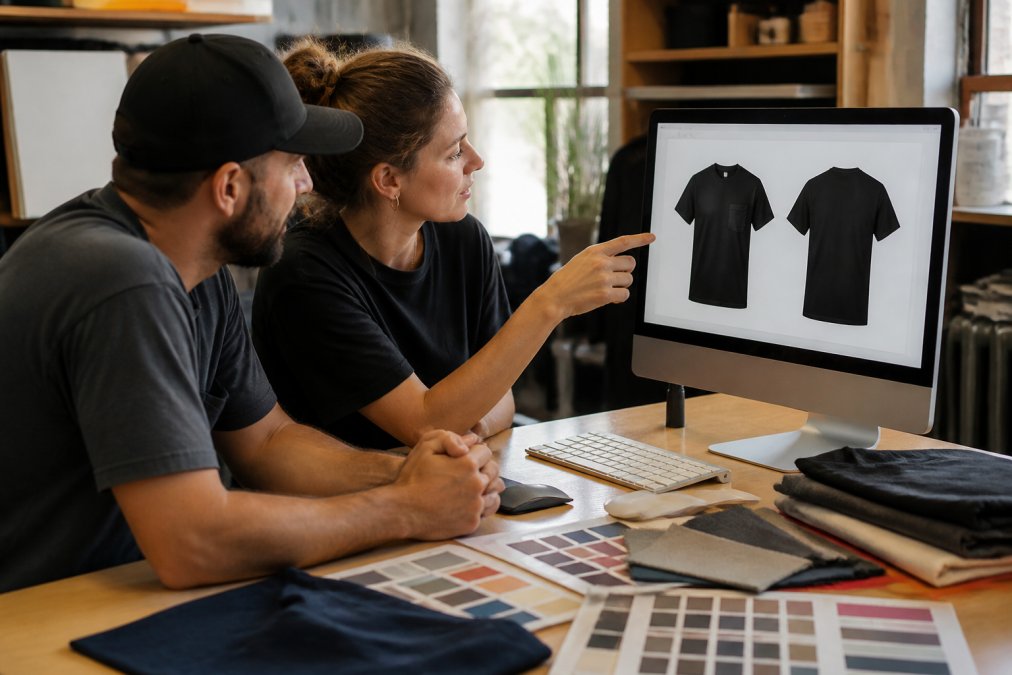
Send vector files in .ai, .eps, or .pdf format. For color, provide Pantone numbers if you have them; otherwise your printer will match to the closest thread or ink available. Ask for a digital mockup and a physical proof on the actual garment before the full run. It is good practice for a vendor to mock up every order and get your approval in writing before printing.
Bulk Pricing, No Minimums, and Rush Delivery: Ordering Without Surprises
Bulk pricing works on a tier system: the more units you order, the lower your cost per unit, because setup costs spread across more pieces. The thresholds vary by method and vendor, but the pattern is consistent. Setup fees apply mainly to screen printing and embroidery digitizing, and they're one-time charges per design, not per shirt.
No-minimum ordering has changed the math for small businesses. You can now order six shirts for a new hire without paying a penalty, though per-unit cost will be higher than a bulk run. The practical approach is to order your core team's apparel in one bulk batch and use small no-minimum runs for new hires and replacements.
For rush delivery, turnaround time is the variable that drives cost.
| Order Size | Typical Approach | Setup Fees | Best Timing |
|---|---|---|---|
| 1-11 units | Digital or heat transfer | None | Any time |
| 12-23 units | Digital or embroidery | Digitizing only | 2-3 weeks |
| 24-99 units | Screen printing | Per color | 2-3 weeks |
| 100+ units | Screen printing | Per color | 3-4 weeks |
Fabric Weight, Washability, and Choosing the Right Garment
The ROI of Custom Apparel for Small Businesses
Sustainable Sourcing and Inventory Management for Merch
Frequently Asked Questions
What is the best printing method for small business custom apparel?
There is no single best method; it depends on order size, design complexity, and fabric. Screen printing offers the lowest cost-per-unit for large runs of simple designs, while digital printing handles full-color or photo-heavy artwork without setup fees. Embroidery adds a professional look for uniforms and polos. For small batches of 10-50 pieces, digital printing or heat transfer usually makes more sense because there are no minimums and no screen setup charges. Ask your printer to mock up your design on the actual garment before you commit.
Is it better to use screen printing or embroidery for business logos?
Screen printing works well for large, flat graphics on t-shirts and event apparel, and it keeps costs low at high quantities. Embroidery is better for corporate uniforms, polos, and outerwear because it holds up to repeated washing and looks more formal. If your logo has fine details or small text, embroidery may lose clarity; screen printing or a printed patch can preserve those elements. Many businesses use both: embroidery for staff apparel and screen printing for giveaways.
Do I need a high-resolution vector file for custom printing?
Yes, a vector file (AI, EPS, or PDF) is ideal because it scales without losing quality. If you only have a JPG or PNG, the print shop may need to redraw it, which can add time and cost. A high-resolution raster file of at least 300 DPI can work for digital printing but may not be suitable for screen printing or embroidery. Before ordering, ask your printer to confirm your artwork meets their requirements and request a digital mockup for approval.
What are the cost factors for small-batch custom apparel printing?
Pricing depends on quantity, number of ink colors or stitch count, garment type, and turnaround speed. Setup fees (screens or digitizing) are common and are spread across the order, so cost-per-unit drops as quantity rises. Rush delivery and specialty fabrics add cost. Since Logo Concepts & Printing does not publish fixed prices, request a quote with your design, quantity, and deadline. They offer free mockups so you can approve the look before production.