 ultimate-guide
How to Design Branded Merchandise for Events
Table of Contents
- Start With Strategy: Audience, Goals, and Budget
- Prepare Custom Artwork and Vector Files That Print Correctly
- Best Promotional Items for Corporate Events
- Event Merchandise Design Tips for Maximum Brand Recall
- Bulk Screen Printing for Events: Methods, Lead Times, and Quality Checks
- Eco-Friendly Sourcing and Accessibility in Event Merch Design
- Logistics, On-Site Storage, and Measuring Post-Event ROI
- Conclusion
- Frequently Asked Questions
Last Updated: September 17, 2026
Start With Strategy: Audience, Goals, and Budget
Designing branded merchandise for events means answering three questions before opening any design software: who will receive it, what it should accomplish, and how much you can spend. This guide from Logo Concepts & Printing covers the full process, from vector files to bulk screen printing for events.
Define Your Target Demographic
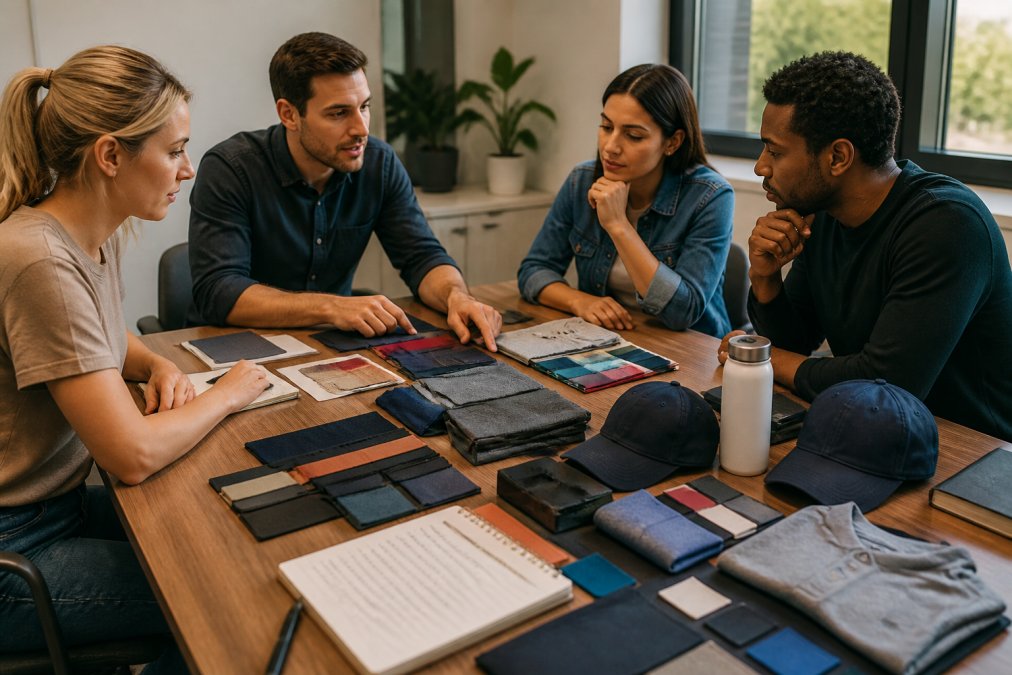
Your target demographic shapes everything from product choice to size run. A construction trade show skews toward durable workwear; an investment firm's client dinner leans toward refined, low-volume items.
- What do they do every day, and what would they use?
- What sizes and quantities do you realistically need?
- What does your brand need them to remember?
Set a Realistic Merchandise Budget
A realistic budget covers more than item cost: build in artwork preparation, setup charges, shipping, and a small overage for replacements. Pricing depends on quantity, decoration method, and timeline, so request a quote rather than guessing.
Prepare Custom Artwork and Vector Files That Print Correctly
Print-ready artwork is the biggest cause of production delays. Vector files scale cleanly to any size, while low-resolution images blur or pixelate when enlarged onto a shirt back or banner. If your only logo file is a small JPG from a website, expect problems.
File Formats Explained: JPG, PNG, SVG, and PDF
Each format serves a different purpose; knowing which to send saves a revision round.
| Format | Best For | Watch Out For |
|---|---|---|
| SVG | Vector logos, scaling to any size | Needs vector editing software |
| Print-ready artwork with fonts outlined | Confirm vector content, not a scan | |
| PNG | Transparent backgrounds, digital use | Loses quality when enlarged |
| JPG | Photos and mockups | No transparency, compresses detail |
Typography, Color Palette, and Visual Hierarchy
Typography and color do more work than most people expect. Stick to your brand fonts and keep the count to two at most; four fonts read as clutter.
Best Promotional Items for Corporate Events
The best promotional items for corporate events are the ones attendees use repeatedly, because repeated use drives brand recall. A sturdy tumbler, quality polo, or well-made tote gets seen for months; a cheap plastic trinket goes in a drawer.
Apparel vs. Non-Apparel Giveaways
Apparel wins on visibility and perceived value but carries sizing and minimum-order considerations. Non-apparel items are simpler to distribute and order in bulk.
- Apparel: polos, t-shirts, hoodies, caps, and jackets. Higher perceived value, stronger brand consistency when worn on the job.
- Non-apparel: drinkware, bags, notebooks, and tech accessories. No sizing, easier bulk ordering, broad appeal.
Event Merchandise Design Tips for Maximum Brand Recall
Maximum brand recall comes from restraint, but the decisions that move it are measurable: where the mark sits, how big it is, how much contrast it carries, and how consistently it repeats. These event merchandise design tips apply whether you order fifty items or five thousand.
Placement: Where the Eye Actually Lands
Placement is not a matter of taste. On a t-shirt, the left-chest print typically sits about 7 to 9 inches below the shoulder seam and 3 to 4 inches in from the placket, sized around 3 to 4 inches wide. A center-front print usually runs 8 to 12 inches wide and starts 2 to 3 inches below the collar.
Contrast, Not Color Count, Drives Legibility
Treating more colors as more impact is a common mistake. A two-color mark on a high-contrast background reads across a room; a five-color mark on a mid-tone background turns to mush at distance. Check ink-to-surface contrast before approving the proof.
Size Runs and Fit: The Quiet Recall Killer
A design that fits no one gets worn once. Order a size run reflecting your actual audience rather than a flat split: a common starting pattern for a mixed adult audience is roughly 10% small, 25% medium, 30% large, 20% XL, and the rest across 2XL and up.
Consistency Beats Cleverness
Use one logo lockup and one placement system across the whole set: if the shirt has the mark on the left chest, the hoodie and polo should too, and if the tote has it in the upper third, the notebook should match. Repetition builds recognition; one-off designs split the impression.
A Quick Pre-Production Checklist
- Confirm placement dimensions against the decorator's chart for each product type
- Check ink-to-substrate contrast on a physical proof, not just a screen mockup
- Verify the size run against your actual attendee profile
- Confirm the same logo lockup and placement across every item in the set
- Approve a physical proof before the full run
Bulk Screen Printing for Events: Methods, Lead Times, and Quality Checks
Bulk screen printing for events rewards planning ahead. Screen printing delivers vivid, durable color on apparel and is the most cost-effective method at volume, but requires setup time and a print-ready file. Embroidery suits smaller logos and heavier garments, especially polos and outerwear.
Screen Printing vs. Embroidery: Which Fits Your Event?
Choose screen printing for large, colorful designs on t-shirts and event apparel. Choose embroidery for smaller logos, left-chest placement, and garments like polos, caps, and jackets where a stitched finish looks more professional. Many events use both: embroidery for staff apparel and screen printing for attendee giveaways.
Eco-Friendly Sourcing and Accessibility in Event Merch Design
Sustainability and accessibility are the two areas most event merch guides skip, and both affect how your brand is perceived. The practical work is in sourcing language, material choices, and design rules that hold up under scrutiny.
Sourcing: What to Ask, and What the Answers Mean
The sustainable option is rarely out of reach, but the vocabulary matters. Ask suppliers specific questions rather than accepting "eco-friendly" as a category:
- Fiber content: Is the cotton organic, recycled, or conventional? Organic cotton is grown without synthetic pesticides under a certified standard; recycled cotton and recycled polyester (often from post-consumer plastic) reduce virgin material demand.
- Certifications: Look for third-party certifications on the product spec sheet. Common ones include GOTS for organic textiles, OEKO-TEX Standard 100 for tested-safe materials, and bluesign for responsible chemical management in textile production. A supplier who can name the certification is a supplier who can document the claim.
- Decoration chemistry: Water-based and plastisol-free inks, and PVC-free heat transfers, reduce the chemical load of the print itself. Ask which ink system your decorator uses and whether a lower-impact option is available for your run.
- End-of-life: A reusable, durable item is the most sustainable choice because it replaces disposables over time. A sturdy tumbler or tote that gets used for years outperforms a compostable trinket that gets thrown away in a week.
Accessibility: Designing for the Full Audience
Accessibility in design is equally practical, and where most competitors offer nothing. Roughly one in twelve men and one in two hundred women have some form of color vision deficiency, so a design relying on red-versus-green to carry meaning fails for a meaningful slice of your audience.
- Do not rely on color alone. Pair color with a shape, icon, or text label so the meaning survives when the color does not.
- Check contrast. For text and fine logo details, aim for a strong contrast ratio between the mark and the background. A common target is a ratio of at least 4.5:1 for body text and 3:1 for large text and graphical elements, following the widely used Web Content Accessibility Guidelines (WCAG) thresholds as a practical benchmark.
- Keep type legible. Avoid thin, light-weight fonts at small sizes, especially on textured fabrics where ink spreads. A heavier weight at a slightly larger size reads better on a shirt than a delicate script.
- Size range, not a single cut. Offer a range of sizes rather than one unisex cut so more attendees can actually wear the item.
- Consider tactile and high-contrast options. For attendees with low vision, a high-contrast mark on a solid background is easier to read than a low-contrast mark on a busy pattern.
Turning the Gap Into a Selling Point
Most event merch is designed for the average attendee and sourced on price alone. A campaign that documents its fiber sourcing and passes a basic contrast check stands out precisely because so few others do it, and gives you something concrete to say in the event materials, follow-up email, and post-event recap.
Logistics, On-Site Storage, and Measuring Post-Event ROI
Logistics decides whether your merchandise reaches attendees. Bulk orders arrive in boxes someone must store, sort, and distribute. Confirm delivery timing, plan a venue staging area, and assign a person to manage the handoff so items are not left in a locked car or distant storage room.
Conclusion
Designing event merchandise that actually gets used takes planning, print-ready artwork, and a partner who understands production timelines. Logo Concepts & Printing brings over 25 years of experience, in-house graphic design, and thousands of customizable products to every campaign, from screen printing and embroidery to full campaign development.
Frequently Asked Questions
How far in advance should I order branded merchandise for an event?
Plan on four to six weeks from artwork approval to delivery for most apparel orders, and longer during peak seasons. Rush jobs are possible in days when the artwork is print-ready and the items are in stock. Build in a buffer for a physical proof and a quality check before the full run, especially if your event date is fixed and cannot move.
What types of event merchandise offer the best return on investment?
Items attendees use repeatedly tend to deliver the strongest brand recall: wearables like t-shirts and caps, drinkware, and tote bags. The key is choosing products that fit your target demographic and the event setting. A construction company's crew will keep a durable work shirt; a bank's clients may prefer a quality notebook. Match the item to daily use, not novelty.
How do I choose the right printing method for event apparel?
Screen printing suits large orders of one or two color designs and offers the lowest cost per piece at volume. Embroidery works better for polos, jackets, and corporate uniforms where a raised logo reads as professional. Ask your vendor to recommend a method based on quantity, fabric, and design complexity.
What are the best design practices for event-specific branding?
Keep it simple. Use one clear logo or message, high-resolution vector files, and a color palette that matches your brand identity. Leave enough contrast for readability at a distance, and avoid placing critical elements near seams or edges. Always approve a product mockup or physical proof before the full run so logo placement is confirmed.
Is there a free tool to design merch online?
Several design software options offer free tiers, and many promotional product vendors provide online design templates. These work well for simple layouts, but complex artwork with gradients, fine detail, or specific Pantone colors usually needs a professional. In-house graphic design teams can convert your logo into print-ready vector files and catch problems before production.
How can I create my own branded merchandise for an event?
Start with your goal and audience, then set a budget per attendee. Gather your logo in vector format, choose products that match how attendees will use them, and settle on a printing method. Request product mockups, approve a proof, and confirm lead times. Working with a full-service vendor from concept through delivery removes the guesswork.