 ultimate-guide
Small Business Custom Printing Services: A 2026 Guide
Table of Contents
- Why Small Business Custom Printing Services Matter for Growth
- How to Choose Small Business Custom Printing Services
- Best Promotional Products for Startups on a Budget
- Custom Packaging Solutions for Small Businesses
- Graphic Design Tips for Custom Print Materials
- Print Marketing vs. Digital: Measuring Real ROI
- Get Started With Your Custom Print Campaign
- Frequently Asked Questions
Last Updated: September 9, 2026
Why Small Business Custom Printing Services Matter for Growth
Print remains one of the most trusted channels for building brand recognition, yet many small businesses treat it as an afterthought. Small business custom printing services bridge the gap between a digital presence and a tangible brand experience, giving customers something they can hold, keep, and remember. The right printed materials can transform casual prospects into loyal customers.
The core advantage of custom printing services is control. You decide the paper weight, the finish, the colors, and the message. That control translates directly into brand consistency, which builds trust over time. A well-executed business card or a branded box signals that you care about details, and customers notice.
The real value, however, shows up in customer acquisition. Every printed piece you distribute becomes a physical ambassador for your business. As documented in research on tactile marketing effectiveness, physical materials create a stronger emotional connection than purely digital ads because they engage multiple senses.
How to Choose Small Business Custom Printing Services
Choosing the right provider comes down to three factors: capability, turnaround time, and design support. The best small business custom printing services offer more than just a web form; they provide guidance on materials, finishes, and specifications so you avoid costly mistakes.
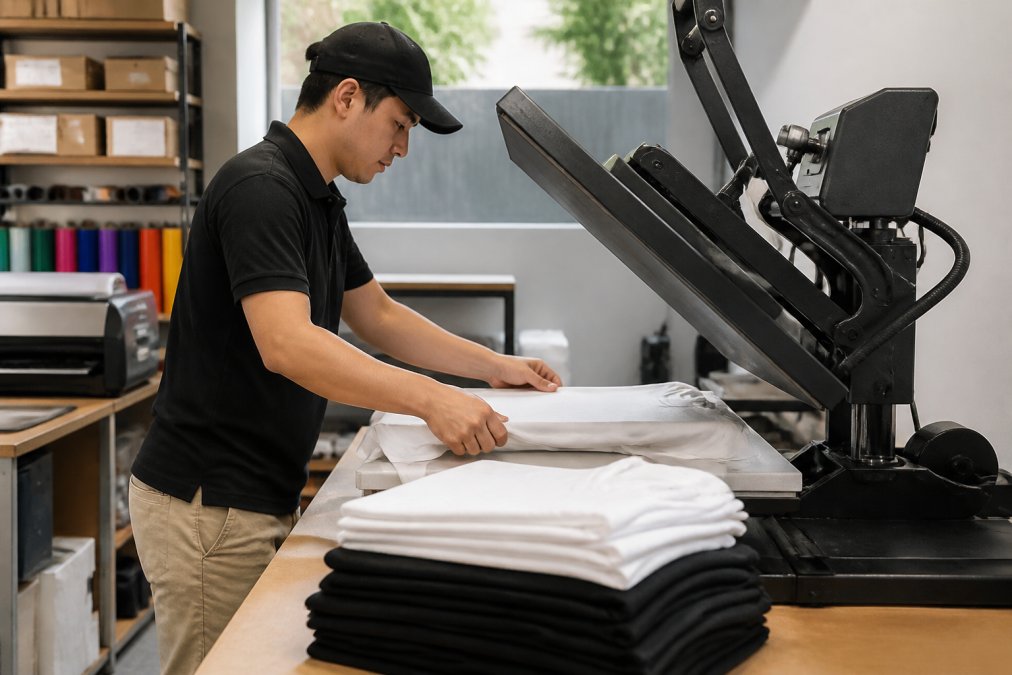
Start by evaluating what you actually need. A startup ordering 50 embroidered polos has different requirements than an established shop ordering 5,000 brochures. Look for a partner that handles both screen printing and embroidery, and one that can source promotional merchandise beyond standard apparel. Access to thousands of customizable items means you are not locked into a limited catalog.
Turnaround time matters more than most owners expect. Marketing campaigns move fast, and a delay in branded materials can derail an entire launch. Ask about rush capabilities before you commit, not when you are already behind schedule. A provider with in-house design and production can often compress timelines that larger, fragmented operations cannot.
Best Promotional Products for Startups on a Budget
High-Impact, Low-Cost Giveaways
Startups rarely have deep marketing budgets, so every dollar must work harder. The most effective promotional products are useful, visible, and aligned with your brand identity. Think about what your target customer will actually keep and use daily, not what is cheapest per unit.
Drinkware, tote bags, and tech accessories consistently perform well because they travel with the user. A branded notebook or pen stays on a desk for months, delivering impressions long after the event where you handed it out. For trade shows and community events, these items generate conversations that lead to customer acquisition.
But the real opportunity for a startup is to choose products that reinforce a specific growth stage. A pre-revenue startup attending a local networking mixer needs a conversation starter, not a high-volume order. A 50-unit run of branded coffee sleeves for a local farmers market booth can put your logo directly in the hands of your target customer. A SaaS company courting enterprise clients, by contrast, should invest in a smaller quantity of premium items, like a branded leather card holder or a high-quality desk charger, because the goal is perceived value, not reach.
Sustainability as a Differentiator
Most promotional product guides focus on price per unit and lead time. What they miss is that a growing segment of small business buyers now evaluates suppliers on environmental impact. Recycled polyester tote bags, bamboo drinkware, and compostable stickers are no longer niche; they are becoming table stakes for brands that market to eco-conscious demographics.
When you request a quote, ask your printing partner three specific questions: (1) What percentage of the product is made from recycled or post-consumer material? (2) Are the inks water-based or plastisol-free? (3) Can you provide a carbon-neutral shipping option? Many national distributors now offer these choices without a significant price premium, especially on orders above 100 units. If a provider cannot answer those questions, that is a signal they are simply reselling a generic catalog rather than acting as a strategic partner.
Print-on-Demand vs. Bulk Orders
This decision shapes your entire inventory strategy. Print-on-demand services integrate directly with e-commerce platforms and require no upfront inventory, making them ideal for testing new designs. However, the per-unit cost is higher, and you sacrifice the tactile quality control that comes with a dedicated production run.
Bulk orders lower the unit price significantly and give you control over materials and finishing. The trade-off is committing to inventory before you know what sells. A balanced approach works best: use print-on-demand for experimental merchandise and reserve bulk printing for core items you know your customers will buy repeatedly.
One overlooked factor is minimum order quantities (MOQs). Many trade show giveaways have MOQs of 250 or 500 units, which can force a startup to overcommit. Ask your provider to source items with lower MOQs, such as stickers, buttons, or seed packets, so you can test a campaign without warehouse overflow. Seed packets, for instance, can align with sustainability messaging and have a near-universal appeal that makes them a smart fit for community-focused events.
Custom Packaging Solutions for Small Businesses
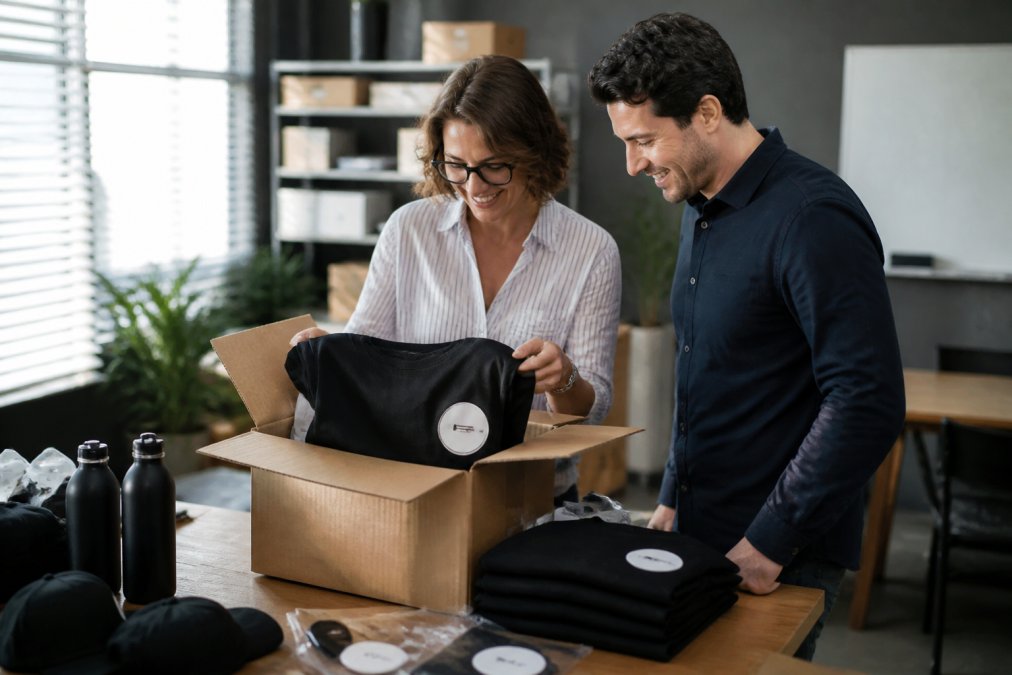
Custom packaging is the most underrated brand asset for e-commerce and retail businesses. The unboxing experience sets the tone for how customers perceive product quality. Custom packaging solutions for small businesses range from simple branded labels and tissue paper to fully customized boxes with interior printing.
For most small businesses, the sweet spot is branded shipping boxes or mailers with custom-printed tape and inserts. These elements create a cohesive experience without requiring a massive minimum order. Labels and stickers also offer a low-cost entry point for adding brand touches to every shipment.
Sustainability is becoming a deciding factor for many buyers. Recycled paper stocks, soy-based inks, and minimal packaging designs reduce your environmental footprint while appealing to eco-conscious customers. Ask your printing partner about eco-friendly materials; many providers now offer these options at competitive price points without sacrificing durability.
Graphic Design Tips for Custom Print Materials
The most common mistake in custom printing is submitting files that are not print-ready. Graphic design tips for custom print materials start with understanding the technical basics. Always work in CMYK color mode rather than RGB, because screens display color differently than ink on paper.
Resolution is another frequent pitfall. Images pulled from websites are typically 72 DPI, which looks pixelated when printed. Professional print requires 300 DPI at the final size (printing.umn.edu). Check your file specifications before uploading to avoid delays and disappointing results.
The Full Pre-Press Checklist
Most small business owners do not have a dedicated graphic designer on staff. That means the burden of file preparation falls on you. A systematic pre-press checklist prevents the majority of production delays and reprint costs.
1. Convert all text to outlines. If you submit a PDF with live fonts, the printer's system may substitute a missing font, shifting your layout or altering your brand voice. Converting text to outlines (also called "curves" in some software) turns every character into a vector shape, guaranteeing the file renders exactly as designed.
2. Embed all images. A PDF that references external image files will print with blank boxes or low-resolution placeholders. Before exporting, verify that every image is embedded in the file. In Adobe InDesign, this appears in the Links panel; in Canva, the export settings handle this automatically, but it is worth double-checking the final PDF.
3. Confirm color profiles. CMYK is the standard for commercial offset and digital printing. If you design in RGB, the printer must convert the file, which can shift colors, especially vibrant oranges and greens. If your brand uses a specific Pantone color, request a Pantone-to-CMYK conversion guide from your printer so you know what to expect on press.
4. Check minimum font size. For most print applications, 6-point type is the practical floor for readability. Anything smaller may become illegible, especially on textured paper stocks or dark backgrounds. For reverse-type (white text on a dark background), use a bolder weight and avoid serif fonts below 8 points.
5. Verify image resolution at final size. A 300 DPI image at 4 inches wide is not the same as a 300 DPI image at 12 inches wide. Resize your images in the design software to their final dimensions before exporting. A common pattern is to design a business card at 200% zoom and then scale down, which inflates the effective resolution, but if you export at the smaller size, the DPI will be higher than the original file actually contains.
Why a Digital Proof Is Not Enough
Proof approval is your safety net. A reputable provider will mock up your order and send a digital proof before production. Review it carefully for typos, logo colors, and placement. This step catches errors while they are still cheap to fix, not after hundreds of items are already printed.
However, a digital proof displayed on a monitor cannot show you how the ink will look on the actual paper stock. Glossy coated paper makes colors appear more vibrant; uncoated paper absorbs ink and dulls them. If color accuracy is critical to your brand, request a physical proof or a printed sample on the exact stock you plan to use. Many printers offer this as an add-on service, and it is a way to verify that your logo's red is the red you approved.
Print Marketing vs. Digital: Measuring Real ROI
The debate between print and digital is a false choice. Both channels work best when they reinforce each other. Print marketing vs. digital is not about picking a winner; it is about creating a system where each medium drives action in the other.
Direct mail remains one of the most effective customer acquisition tools, particularly when paired with a QR code or personalized URL that leads to a landing page. This integration lets you track response rates precisely while giving recipients a tangible reason to engage. According to the United States Postal Service's mail study, physical mail requires less cognitive effort to process and yields higher brand recall than digital-only exposure.
For small business scalability, start with a simple measurement framework. Use unique promo codes on printed materials, dedicated phone numbers, or campaign-specific landing pages. These tools tell you exactly which printed piece drove the inquiry, allowing you to double down on what works and cut what does not.
Get Started With Your Custom Print Campaign
Planning a successful print campaign does not require a marketing degree, but it does require a partner who can guide you through the process. The right small business custom printing services provider should offer campaign development, product sourcing, and design assistance from concept to delivery.
At Logo Concepts & Printing, our in-house graphic design team handles everything from logo refinement to full campaign mockups. With over 25 years of experience and access to thousands of logo items through our affiliation with iPromoteu, we can source competitive pricing on products you will not find in standard catalogs. We mock up every order before production so you approve exactly what will be printed.
A common mistake is waiting until a campaign is urgent before sourcing materials. Give yourself a buffer for proof approval and production. Many businesses find that working with one dedicated partner across multiple campaigns builds institutional knowledge that speeds up every subsequent order.
Starting a print campaign can feel overwhelming, especially when you are juggling design, sourcing, and deadlines. That is where experienced guidance makes the difference. Logo Concepts & Printing pairs professional design services with rapid turnaround and competitive pricing, so your brand looks polished without stretching your budget. Whether you need custom apparel, branded merchandise, or marketing collateral, our team will walk you through every step. Get started today and see how professional printing elevates your next campaign.
Frequently Asked Questions
How much do small business custom printing services cost?
Pricing depends on the product, quantity, and decorating method. Bulk orders lower the per-item cost, while specialty items or fast turnaround times raise it. Print-on-demand platforms charge per product with no minimums, but margins are thinner. Commercial printers often provide better rates for volume. Get quotes from several providers and compare the unit price, setup fees, and shipping. For a specific estimate, contact the printing service directly with your project details.
What file formats do I need for high-quality custom printing?
Most print shops prefer vector files like AI, EPS, or PDF because they scale without losing quality. If you only have a PNG or JPG, ensure it is at least 300 DPI at the final print size. Set your document to CMYK color mode, not RGB, to prevent color shifts. Add a 0.125-inch bleed to any design that touches the edge, and keep important text within the safe margin. When in doubt, ask the printer for their file specifications before you upload.
What are the best promotional products for startups?
Startups typically need items that are useful, compact, and align with their brand voice. Popular choices include branded notebooks, drinkware, tech accessories like phone grips or charging cables, and reusable tote bags. Apparel like t-shirts and hats works well for team building and casual giveaways. If you are testing a product line, print-on-demand services let you order small batches without inventory risk. Focus on items your target customer will actually use daily for sustained brand visibility.