 how-to
Why Custom Apparel Production Takes Time
Table of Contents
- Understanding Custom Apparel Production Timelines
- Design Approval and Artwork Setup
- Fabric Sourcing and Material Procurement
- Custom Apparel Production Timeline: Stage-by-Stage Breakdown
- How Long Does Custom Apparel Printing Take
- Screen Printing Turnaround Time and Decoration Methods
- Factors That Delay Garment Production
- Planning Backward: Order Timing and Rush Options
- Frequently Asked Questions
Last Updated: October 18, 2026
Understanding Custom Apparel Production Timelines
Ordering custom apparel requires design approval, sourcing, pattern making, cutting, sewing, decoration, and quality checks, which is why custom apparel production doesn't happen overnight.
At Logo Concepts & Printing, we work with businesses that need branded merchandise for teams, events, and marketing campaigns. Timelines depend on order quantity, decoration method, design complexity, and how quickly you approve artwork.
Here's why custom apparel production takes time and how to work within realistic timelines.
Design Approval and Artwork Setup
Many delays happen at design approval, not because factories are slow, but because artwork needs sign-off.
When you submit your logo or design, we convert it into a production-ready file, a process called artwork setup. Screen printing requires color separation, embroidery requires digitizing, and direct-to-garment printing requires file optimization.
You review the proof, request changes, and we revise. This typically takes 3-5 business days but stretches longer if approvals move slowly on your end. Production cannot start until you sign off.
Fabric Sourcing and Material Procurement
Custom apparel starts with fabric and blank garments. Standard items in common sizes and colors come from existing inventory; specialty fabrics, unusual colors, or specific fits must be sourced.
A standard blank tee in black, white, or navy is usually in stock; a custom-dyed organic cotton blend in a specific shade carries a 2-3 week lead time before production begins.
Order quantity also affects sourcing. Large orders (500+ units) may require special runs. Smaller orders (under 50 units) sometimes take longer because we're pooling your request with other customers' orders to meet minimum purchase quantities.
Custom Apparel Production Timeline: Stage-by-Stage Breakdown
Custom apparel production moves through predictable stages, but timing varies based on order size, decoration method, and complexity. The table below shows typical business-day ranges for each phase. These are planning ranges, not guarantees; your quote should confirm the specific schedule for your order.
| Stage | Typical range (business days) | What drives the range |
|---|---|---|
| Artwork setup and proof approval | 3-5 | Number of colors, file quality, speed of your sign-off |
| Fabric and blank sourcing | 0-15 | In-stock vs. special dye or custom mill run |
| Pattern making and grading | 3-5 | New pattern vs. existing block |
| Sampling and fit approval | 5-10 | Number of sample rounds |
| Cutting and sewing | 5-15 | Unit count, garment complexity |
| Decoration | 2-14 | Method, color count, stitch count, quantity |
| Quality control and packing | 1-3 | Inspection standard, unit count |
| Shipping | 1-7 | Service level and distance |
Pattern Making and Sampling
Pattern making takes 3-5 business days: we grade the pattern for different sizes, cut and sew a sample, and send it for fit approval. Each additional sample round adds 5-10 business days including transit both ways.
Cutting, Sewing, and Assembly
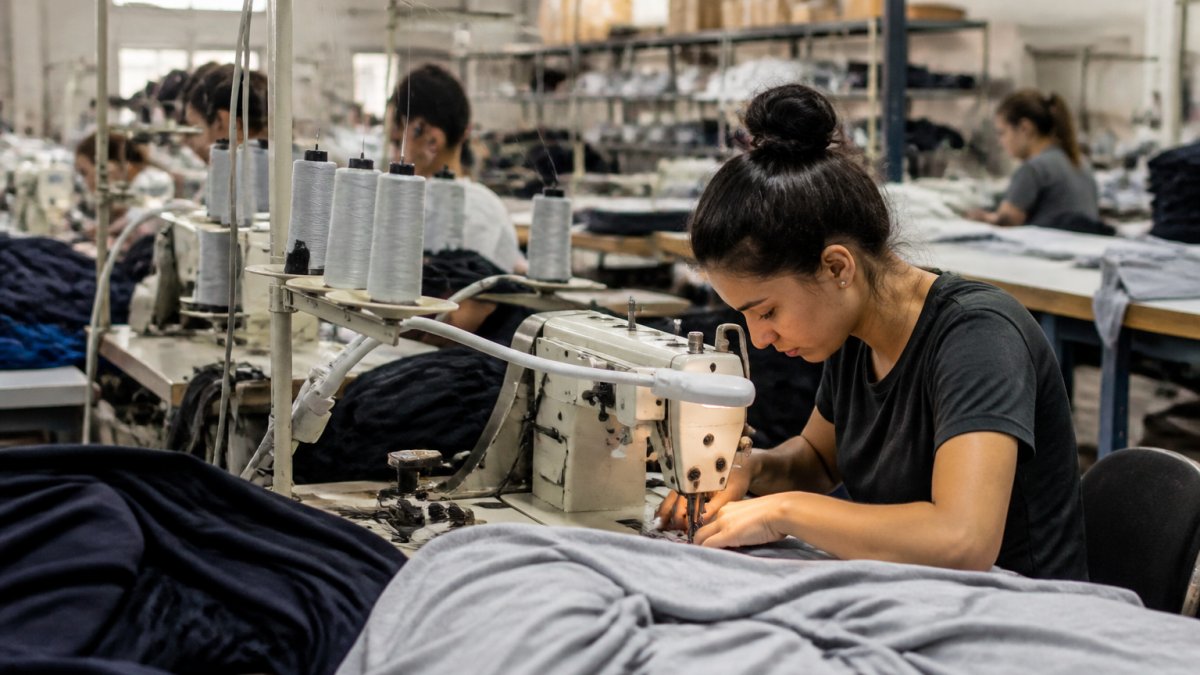
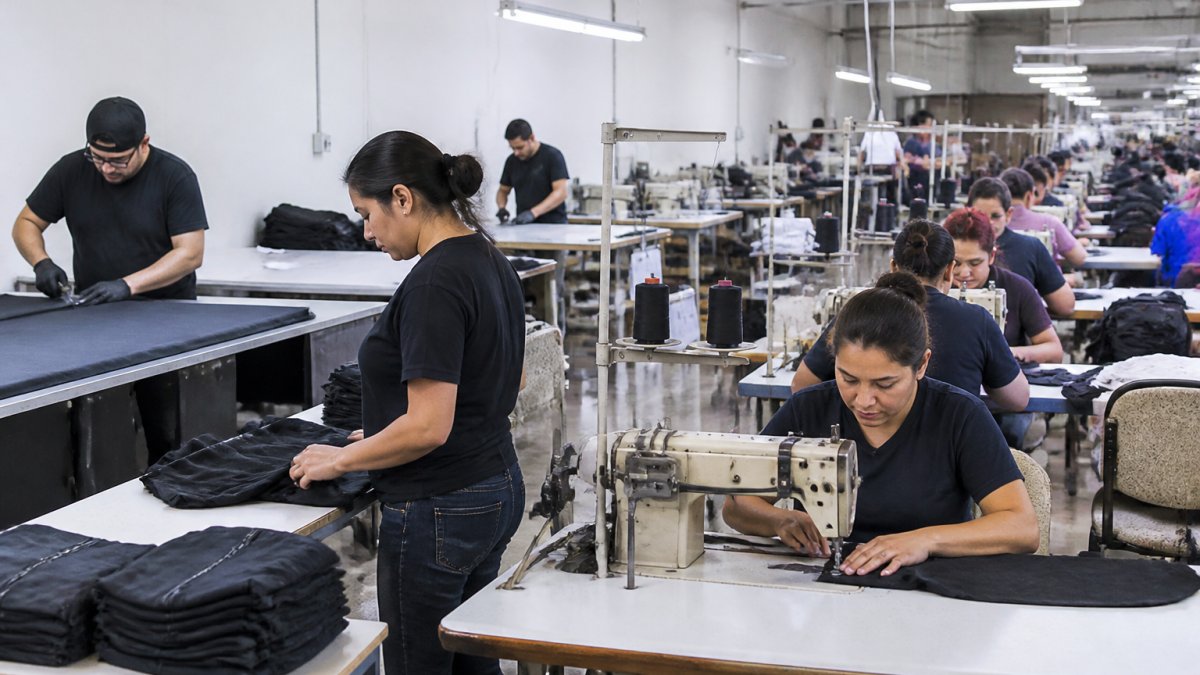
Once patterns are approved and fabric is in hand, pieces are cut using templates or automated systems, then sewn, hemmed, and assembled.
Decoration and Finishing
This is where your branding gets applied. The method you choose determines timing significantly.
Screen printing involves creating screens for each color, then printing each color in sequence. Screen creation takes 1-2 business days, and curing time between colors is built in. Each additional color adds setup and press time.
Embroidery requires digitizing your design (1-2 business days), then stitching it onto each garment. Each stitch is placed individually: a small left-chest logo may run 10-15 minutes per garment, while a large back design can run 30-45 minutes or more.
Direct-to-garment printing uses inkjet technology to print directly onto fabric. Setup is minimal, but each garment must cure, limiting throughput on large runs.
Worked Timeline Examples
These examples assume no design changes after approval and standard shipping.
- Small decorated run (50 units, 1-color screen print on in-stock tees): artwork 3 days, sourcing 0 days (in stock), no sampling, decoration 2-3 days, QC and packing 1 day, shipping 2-3 days. Total: roughly 8-10 business days.
- Custom cut-and-sew order (300 units, new pattern, specialty fabric): artwork 3-5 days, fabric sourcing 10-15 days, pattern and sampling 10-15 days including one approval round, cut and sew 10 days, decoration 5-7 days, QC 2 days, shipping 3-5 days. Total: roughly 6-8 weeks.
- Large repeat order (1,000 units, existing pattern, 3-color screen print): artwork 3 days, sourcing 3-5 days, no sampling, cut and sew 12-15 days, decoration 7-10 days, QC 3 days, shipping 3-5 days. Total: roughly 5-7 weeks.
Use these as planning anchors, then confirm the actual schedule with your supplier. The biggest swing factor is how fast artwork and samples are approved on your side.
How Long Does Custom Apparel Printing Take
| Method | Setup time | Best-fit quantity | Throughput behavior | Typical total range |
|---|---|---|---|---|
| Screen printing | 1-2 days (screen creation per color) | 100+ units | Fast at scale; setup dominates small runs | 5-14 business days |
| Embroidery | 1-2 days (digitizing) | Any quantity | Time per garment driven by stitch count | 7-10 business days for 100 units |
| Direct-to-garment | Minimal | Under 100 units | Fast small runs; curing limits large runs | 3-5 days for 50; 10-14 days for 500 |
| Heat transfer | Minimal | Small to mid runs | Fast setup; pressing time per unit | 3-7 business days |
Screen printing is fast for large orders but requires setup. Creating screens takes 1-2 days; once ready, printing moves at dozens of shirts per hour.
Embroidery is slower overall. Digitizing takes 1-2 days, and stitching depends on stitch count: a small 2-color logo might take 15 minutes per garment, a large detailed design 45 minutes or more.
Direct-to-garment printing is fast for small orders and slower for large ones. Setup is minimal, but each garment must cure individually: expect 3-5 days for 50 units and 10-14 days for 500.
Heat transfer has minimal setup and suits photo-realistic designs or small orders. Pressing time per unit is the main constraint: for 100 units, expect 3-7 business days depending on design size and press capacity.
What Can and Cannot Be Compressed
Rush service can shorten some parts of the decoration schedule but not others. Queue priority and parallel processing can move your order ahead and overlap stages, but screen creation, embroidery digitizing, and curing time have inherent minimums. If your deadline depends on compressing those steps, the schedule needs more room, not a faster vendor.
Screen Printing Turnaround Time and Decoration Methods
Screen printing turnaround time depends on order size, design complexity, and current production queue.
A simple single-color design on 100 shirts takes 5-7 business days total (including artwork approval and shipping prep). A complex 5-color design on 500 shirts takes 10-14 business days. Rush orders are possible, but you can't rush screen creation or curing time, only queue priority and parallel processing.
Different decoration methods have different speed profiles:
- Screen printing: Best for large orders (100+ units). Slower for small orders. Complex multi-color designs add time.
- Embroidery: Consistent timing regardless of order size. Design complexity and stitch count matter more than quantity.
- Direct-to-garment: Fast for small orders (under 100 units). Slower for large orders due to curing time per garment.
- Heat transfer: Fast overall. Minimal setup. Good for photo-realistic designs or small orders.
Match the method to your order size and budget: small orders often print faster with embroidery or heat transfer, while large orders benefit from screen printing's speed at scale.
Factors That Delay Garment Production
Several factors can stretch your timeline beyond standard estimates.
Design changes after approval reset the clock.
Out-of-stock sizes or colors force us to wait for restocking. If XL is out of stock, the entire order is delayed until stock arrives.
Complex artwork requires more setup time. Photo-realistic designs, gradients, or intricate details take longer to prepare for any printing method.
Approval delays on your end are the most common cause of extended timelines. If your team is slow to review proofs or sign off, the entire production schedule shifts.
Current production queue matters. During peak seasons (summer for events, Q4 for holiday merchandise), production facilities are busier. Standard timelines stretch by 2-3 days.
Rush fees and expedited options exist, but they have limits. You cannot rush fabric sourcing if materials aren't in stock, nor screen creation or embroidery digitization.
Planning Backward: Order Timing and Rush Options
The best way to ensure you get your custom apparel on time is to work backward from your deadline.
If your event is in 8 weeks, here's how to allocate time:
- Week 1-2: Finalize design, gather approvals internally, submit artwork to us
- Week 2-3: Artwork setup and approval (3-5 days), plus your internal review (2-3 days)
- Week 3-4: Fabric sourcing and pattern approval (if needed)
- Week 4-9: Production, decoration, and quality control (5-10 business days depending on method and volume)
- Week 9-10: Quality inspection, packing, and shipping
This timeline assumes standard orders and no major changes. If you need rush service, contact us immediately. We can sometimes compress timelines by prioritizing your order, but we cannot eliminate certain steps.
What cannot be rushed:
- Fabric sourcing for specialty materials (if not in stock, sourcing takes 2-3 weeks minimum)
- Artwork approval (we need your sign-off before production)
- Screen creation or embroidery digitization (these have inherent minimum times)
- Curing and drying time for certain printing methods
What can be expedited:
- Queue priority (we move your order to the front)
- Faster shipping (express delivery costs more but saves 2-3 days)
Start early, confirm material availability before committing to a deadline, and build in buffer time for approvals.
Getting branded apparel right takes planning, but it's worth it: quality custom apparel builds team unity and strengthens your brand presence. At Logo Concepts & Printing, we've guided thousands of businesses through this process with our in-house design team and transparent timelines, handling everything from artwork setup to final delivery so you don't have to manage multiple vendors. Ready to start your custom apparel project? Contact us today to discuss your timeline, budget, and design vision.
Frequently Asked Questions
How long does custom apparel production typically take?
Most custom apparel orders take 4 to 6 weeks from design approval to delivery. This includes design finalization, fabric sourcing, production, decoration (screen printing or embroidery), quality inspection, and shipping. Rush orders may compress this to 2 to 3 weeks, but not all stages can be accelerated. Order quantity, decoration complexity, and fabric availability directly affect your timeline.
What are the main factors that delay garment production?
Common delays include design revision cycles, fabric procurement delays, complex artwork requiring multiple color separations, out-of-stock sizes, quality control issues requiring rework, and shipping logistics. Approval bottlenecks, when decision-makers delay sign-off on designs, often add 1 to 2 weeks. Communicating clearly and approving artwork quickly removes controllable delays from your custom apparel production timeline.
How long does screen printing turnaround time take compared to embroidery?
Screen printing typically takes 1 to 3 weeks for production and decoration combined, depending on color count and order size. Embroidery usually takes 2 to 4 weeks because each piece is stitched individually. Complex designs with many colors or intricate stitching extend both timelines. Direct-to-garment printing offers faster turnaround (sometimes 1 to 2 weeks) for small orders but costs more per unit. Discuss decoration method options with your vendor early to align with your event or campaign date.
Can I rush a custom apparel order, and what stages cannot be expedited?
Fabric sourcing cannot be rushed significantly, material must be ordered before production begins. This step typically accounts for 2 to 3 weeks. Decoration can be prioritized to run faster. Shipping, however, depends on carrier schedules. If you need apparel urgently, order fabric that is in stock, keep designs simple, and discuss rush production fees with your vendor upfront.