 how-to
Custom Branded Merchandise Increases Employee Engagement
Table of Contents
- Why Branded Merchandise Matters for Remote Employee Engagement
- How Branded Merchandise Builds Team Unity and Belonging
- Remote Employee Welcome Kit Ideas That Create Connection
- Employee Recognition Gift Ideas That Show You Care
- Company Swag Ideas for Employees That Actually Get Used
- Setting Up a Company Merchandise Store for Your Team
- Measuring the Impact of Branded Merchandise on Engagement
- Frequently Asked Questions
Last Updated: October 20, 2026
Why Branded Merchandise Matters for Remote Employee Engagement
Branded merchandise employee engagement isn't just about handing out t-shirts and hoping people wear them. It's a strategic tool that connects distributed teams, reinforces company culture, and shows employees they matter.
Remote work has fundamentally changed how companies build culture, making branded merchandise employee engagement a strategic priority. Without the office watercooler, you need intentional ways to foster connection. This is where branded merchandise steps in.
The right merchandise strategy can strengthen remote teams. The key is moving beyond generic swag to items employees actually want to use.
How Branded Merchandise Builds Team Unity and Belonging
Remote employees often feel disconnected from their peers. Branded merchandise creates a shared visual identity that bridges that distance.

The psychology is straightforward: shared symbols create shared identity. A sense of belonging drives engagement. Employees who feel connected to their team are more likely to:
- Participate actively in virtual meetings and team events
- Collaborate more openly with colleagues
- Stay with the company longer
- Advocate for the brand outside of work
Quality matters here. Cheap merchandise that falls apart after a few washes sends the wrong message. It signals that the company doesn't value employees highly enough to invest in something durable.
Consider the practical impact: when a remote employee wears company-branded apparel during client calls or community events, they become a walking ambassador.
Remote Employee Welcome Kit Ideas That Create Connection
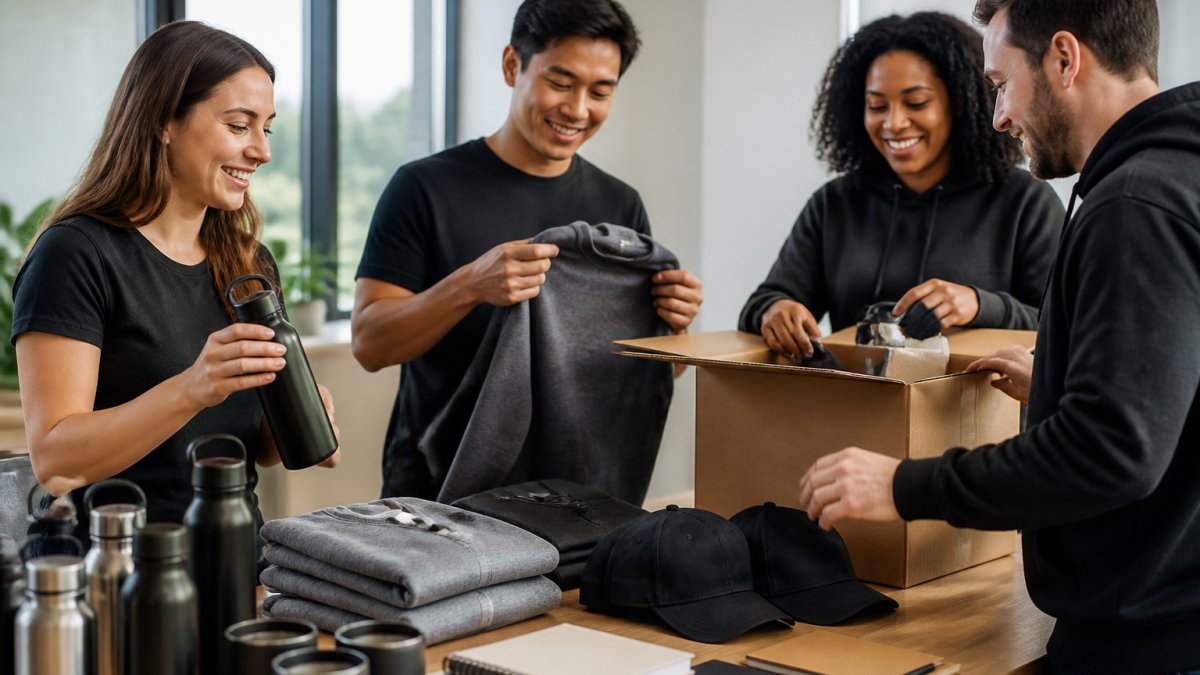
New hires in remote environments face a unique challenge: they join a team they've never met in person. A thoughtfully curated welcome kit changes that experience dramatically. It's the first physical touchpoint with company culture, and it sets the tone for their entire tenure.
Effective welcome kits combine practical items with meaningful touches:
- Branded apparel (hoodie, t-shirt, or polo) that fits well and looks professional
- Desk essentials (notebook, pen, or desk organizer) with company branding
- Comfort items (coffee mug, water bottle, or cozy socks) for daily use
- A handwritten note from leadership welcoming them to the team
- Company swag that reflects your culture (if your brand is playful, include fun items; if it's corporate, keep it polished)
The timing matters. Ship the kit before their first day so it arrives when they're settling in. This shows intentionality and makes them feel valued before they've even started.
Remote employee welcome kit ideas work best when they're personalized. If you know a new hire loves coffee, include a premium mug. If they're into fitness, add a branded water bottle.
Employee Recognition Gift Ideas That Show You Care
Recognition drives engagement more than most leaders realize. When employees feel appreciated, they perform better and stay longer. Branded gifts tied to recognition programs amplify this effect because they're tangible reminders of achievement.
Effective employee recognition gift ideas include:
- Branded apparel upgrades (premium jacket or performance gear) for major milestones
- Customized items (engraved water bottle, personalized notebook) for specific achievements
- Experience gifts (gift cards, team event sponsorships) paired with branded merchandise
- Desk displays (plaques, awards, or framed certificates) with company branding
- Seasonal gifts (holiday packages, summer items) that feel generous and thoughtful
The key is connecting the gift to the achievement. Don't just hand out merchandise randomly. Use it strategically within your recognition program. It transforms from generic swag into a symbol of accomplishment.
Timing and presentation matter. Present the gift during a team meeting or all-hands call so peers see the recognition. This amplifies the motivational impact and shows the entire team that achievement is valued.
Company Swag Ideas for Employees That Actually Get Used
Most company swag ends up in a drawer or donation pile. The difference between items people keep and items people discard comes down to utility and quality.
High-utility items that employees actually use:
- Performance apparel (moisture-wicking shirts, comfortable hoodies, athletic wear) for daily wear
- Desk accessories (ergonomic mouse pads, monitor stands, cable organizers) that improve workspace comfort
- Drinkware (insulated tumblers, water bottles, coffee mugs) for everyday use
- Tech accessories (phone stands, charging cables, wireless earbuds) that solve daily friction
- Outdoor gear (hats, jackets, backpacks) for active employees
The worst swag is items that serve no purpose. A branded stress ball or cheap pen gets tossed. A high-quality water bottle or comfortable t-shirt stays in rotation for years.
Quality merchandise also reflects on your company's professionalism. When a remote employee uses branded items during client calls or community events, it influences how outsiders perceive your organization. Premium merchandise signals investment and care. Budget options signal the opposite.
Setting Up a Company Merchandise Store for Your Team
A company merchandise store gives remote employees choice and control, which matters more when you cannot hand someone a shirt in person. But a store only works if the logistics behind it are realistic. Many programs fail on fulfillment, sizing, and budget, not on design.
Step 1: Set a realistic per-person budget
Start with a per-employee annual allowance rather than an open-ended catalog. A common pattern is to tier allowances by tenure or role (for example, a new-hire welcome allotment plus a smaller annual refresh). Build the budget from four cost lines, not one:
- Product cost, the blank item plus decoration (screen print, embroidery, or heat transfer)
- Fulfillment and pick-pack, per-order handling fees charged by most store platforms
- Shipping, domestic ground versus expedited, and international duties and taxes if you have employees outside the U.S.
- Platform and admin fees, monthly store fees, payment processing, and returns handling
Ask your vendor for an all-in landed cost per item before you publish the store. A $30 hoodie can become a $45 hoodie once decoration, pick-pack, and shipping are added.
Step 2: Choose an ordering model
There are three common models, and they trade off cost against waste:
- Bulk inventory, lowest unit cost, but you carry dead stock and storage. Works when you have predictable sizes and a large headcount.
- On-demand (print-on-demand), no inventory, higher unit cost, longer lead times. Works for small teams or broad catalogs where you cannot forecast demand.
- Hybrid, bulk-buy core items (hoodie, tee) and use on-demand for accessories and seasonal drops.
For distributed teams, on-demand or hybrid usually wins because you avoid shipping boxes of inventory between offices that no longer exist.
Step 3: Collect sizes and addresses without friction
This is where remote programs stall. Build a single intake form that captures size, shipping address, and preferences at onboarding, and let employees update it in the store. Offer a size chart with garment measurements, not just S/M/L, because fit varies by brand. For international employees, confirm whether you will ship directly or use a local fulfillment partner to avoid customs delays and surprise duties.
Step 4: Make the store easy to use
- Integrate with your HRIS or SSO so employees do not create another password.
- Show the allowance balance clearly and let employees see what they have left.
- Publish lead times next to each item so no one expects a hoodie in three days when it ships in three weeks.
- Offer a small, curated catalog rather than a hundred SKUs; too much choice suppresses orders.
Step 5: Plan fulfillment and follow-up
Set a shipping cadence (for example, weekly batch shipments) to control costs. Track order status and send a confirmation when items ship. After delivery, send a short survey asking whether the item fit and whether they use it. Use that feedback to prune low-performing SKUs each quarter.
A store is not a set-and-forget benefit. Treat it like any other operational program: budget it, measure it, and refresh it. Logo Concepts & Printing can help you design the catalog and manage production and fulfillment.
Measuring the Impact of Branded Merchandise on Engagement
Most articles on branded merchandise assert that it boosts engagement and stop there. That is a missed opportunity, because a merchandise program is easy to measure if you set a baseline before you launch. The honest framing is this: merchandise is a supporting input, not a replacement for good management, recognition, and pay. Measure it as one variable among several.
Establish a baseline first
Before you ship the first welcome kit, capture a snapshot:
- Belonging and connection scores from your existing engagement survey (most survey tools include items on belonging, recognition, and intent to stay)
- Voluntary turnover rate for the trailing 12 months
- Virtual event attendance rate as a percentage of invited employees
- New-hire 30/60/90-day check-in feedback on onboarding experience
Without a baseline, any post-launch number is anecdotal. Record the date you launched so you can compare like-for-like periods.
Track program participation
Participation is the most direct signal that the program is working:
- Percentage of eligible employees who ordered from the store or received a kit
- Redemption rate of the annual allowance
- Repeat order rate (did employees come back for a second item?)
- Welcome-kit delivery confirmation rate and address-collection completion rate
A low redemption rate usually points to a catalog problem (items nobody wants), a communication problem (employees do not know the store exists), or a logistics problem (shipping is slow or confusing). Diagnose before you conclude the concept failed.
Use a simple before-and-after comparison
You do not need a controlled experiment to learn something useful. A common pattern is a pre/post comparison on the same survey items, measured at least two quarters apart:
- Survey belonging and recognition items before launch.
- Launch the program and communicate it clearly.
- Re-survey the same items after 6-12 months.
- Compare the change against a comparison group if you have one (for example, a team that received kits later).
Be careful about attribution. Engagement scores move for many reasons, a new manager, a pay adjustment, a reorg. If scores rise after launch, that is a signal, not proof. Say so plainly in your reporting.
Add qualitative signals
Numbers miss context. Ask employees directly in short pulse surveys or focus groups:
- Do you wear or use the items regularly?
- Did the welcome kit change how you felt in your first weeks?
- Does the merchandise make you feel more connected to the team?
- What would you change about the catalog?
Qualitative feedback is where you find the fixable problems, sizing runs small, shipping took three weeks, the mug broke in transit.
Report honestly, including limitations
Present merchandise results alongside the caveats:
- Merchandise cannot compensate for poor management, unclear expectations, or uncompetitive pay.
- Small teams produce noisy data; a five-person team cannot show statistically meaningful survey movement.
- Self-reported belonging is subjective and influenced by survey timing and current events.
Set a review cadence
Review program metrics quarterly and run a fuller engagement comparison annually. If participation is low or survey items are flat, adjust the catalog, the communication, or the budget before expanding the program. Measurement is what turns merchandise from a cost line into a managed engagement input.
Frequently Asked Questions
How does branded merchandise improve employee engagement?
Branded merchandise creates a tangible connection to company culture and values. When remote employees wear or use items with your company logo, they feel part of a shared identity and team purpose. This physical representation of belonging increases pride in their work and strengthens their emotional connection to the organization, leading to higher motivation and retention.
What should go in a remote employee welcome kit?
An effective remote employee welcome kit combines practical and meaningful items. Include branded apparel (t-shirt or hoodie), a quality water bottle or mug, a notebook, writing tools, and a handwritten welcome note from leadership. Add items that reflect your company values, sustainable products, tech accessories, or items supporting work-from-home comfort. The goal is to make new hires feel immediately valued and connected to company culture despite physical distance.
How do you choose useful company swag for employees?
Focus on items employees will actually use daily rather than novelty products that end up in a drawer. Prioritize comfort and quality: branded apparel in multiple sizes, ergonomic office accessories, insulated drinkware, and items that support remote work (laptop stands, desk organizers). Survey your team about preferences, consider seasonal needs, and ensure items align with your brand values. Quality merchandise reflects positively on your company and gets genuine use and visibility.
When should employers send gifts to remote employees?
Send branded merchandise at key moments: onboarding and welcome packages for new hires, milestone celebrations (work anniversaries, project completions), recognition for exceptional performance, and company-wide events or launches. Seasonal gifts during holidays or summer can also boost morale. Timing these gifts strategically reinforces company values and makes employees feel appreciated at moments when connection matters most, especially for distributed teams lacking in-person interaction.