 how-to
7 Steps to Design Company Apparel for Branding
Last Updated: November 2, 2026
Quick Summary
To design company apparel for branding, define your goals and audience first, then prepare print-ready vector logo files before choosing garments and printing methods. Match the printing method to the garment, standardize logo placement and colors, and approve a mockup before committing to production.
- Ask who wears the apparel, what it should do, and where it will appear before choosing a garment.
- Vector files (AI, EPS, SVG, PDF) scale without losing edge quality; raster files can pixelate when enlarged.
- Screen printing suits bulk orders and bold designs, while direct-to-garment fits small runs and detailed art.
- A logo on the left chest plus a name on the right chest is the classic workwear layout for service teams.
- Bulk ordering generally lowers the per-piece cost because setup costs spread across more units.
Table of Contents
- Step 1: Define Your Apparel Goals and Audience
- Step 2: Prepare Your Logo Files for Printing
- Step 3: Choose Garments and Printing Methods That Fit Your Brand
- Step 4: Nail Logo Placement, Sizing, and Color Choices
- Step 5: Custom Apparel for Small Business Budgets and Bulk Orders
- Step 6: Business Shirts With Logo and Name That Look Professional
- Step 7: Design Clothes Online Free Before You Commit
- Custom Logo Apparel No Minimum: What Small Teams Should Know
- Frequently Asked Questions
Step 1: Define Your Apparel Goals and Audience
Company apparel is branded clothing a business puts on its team, customers, or event guests to build recognition. Getting it right starts well before you pick a shirt. According to market research on custom apparel printing, the custom t-shirt printing market is valued between $4.57 billion and $7.01 billion, growing 8% to 9.7% a year. At Logo Concepts & Printing, we have spent over 25 years watching that growth, and one pattern holds: businesses that define goals first get better results.
Ask three questions before anything else:
- Who wears it? Staff, customers, event guests, or all three?
- What should it do? Build brand awareness, reward loyalty, or outfit a team?
- Where will it appear? A job site, a trade show, a retail floor?
A construction crew needs durable workwear. A community bank needs a polished polo. Same logo, different garment. That gap matters for every step that follows.
Step 2: Prepare Your Logo Files for Printing
Print-ready artwork is the single biggest factor in how sharp your finished apparel looks, and it is the step where most reprints originate. The core distinction is vector versus raster. Vector files (AI, EPS, SVG, PDF) are built from mathematical paths, so they scale to any size without losing edge quality. Raster files (PNG, JPG, TIFF) are grids of pixels; they look fine on a screen and fall apart the moment a printer enlarges them beyond their native resolution.
Here is the resolution math that matters. Printers generally want raster artwork at high resolution for the final print size. If your only logo file is a small PNG pulled from a website, it will likely not hold up at larger sizes, and that is hard to fix after the fact.
Here is what a print studio typically needs from you:
- Vector logo files in the original format, with editable paths
- A one-color version and a full-color version
- Typography outlined or embedded so fonts do not substitute
- A brand guideline sheet with exact color codes
Color matching deserves its own note. Screen colors and fabric colors do not behave the same way, and the same color can read differently on a cotton tee than in embroidery thread, because fabric absorbs ink and thread reflects light. Ask your vendor to confirm color matches on an actual garment, not on a monitor.
Watch out: sending a screenshot, a logo pulled from a website, or a JPG that has been texted and re-saved causes pixelation and color shift, and neither can be fixed after printing. Low-contrast color choices and oversized logos hurt first impressions too, according to Vistaprint Corporate's design guidance. Artwork preparation is boring work. It is also the step that decides whether your apparel line looks professional or homemade.
A practical checklist before you send files: confirm the vector source exists, confirm the one-color version is truly one color, confirm fonts are outlined, and confirm the color codes are documented.
Step 3: Choose Garments and Printing Methods That Fit Your Brand
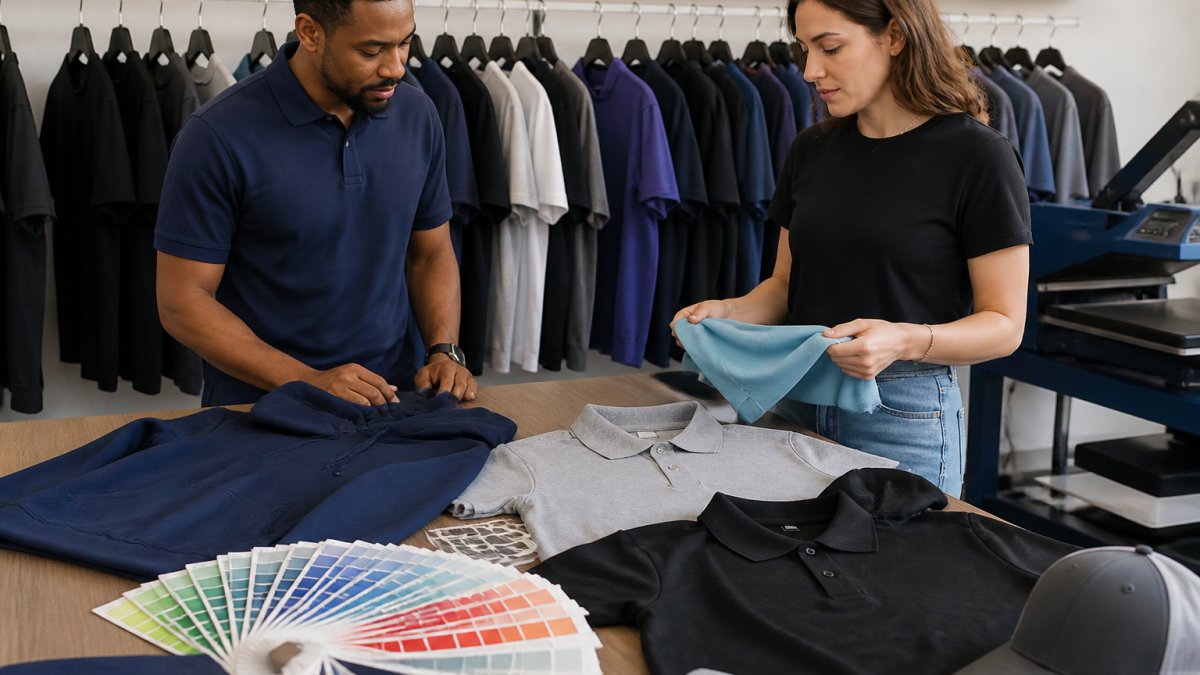
Several printing methods cover most company apparel needs, and each fits a different job. Match the method to the garment, not the other way around.
| Method | Best For | Works Best On | Watch Out For |
|---|---|---|---|
| Screen printing | Bulk orders, bold designs | Cotton t-shirts, hoodies | Setup cost per color |
| Embroidery | Polos, workwear, jackets | Wovens, knits, hats | Small text can blur |
| Direct-to-garment | Small runs, detailed art | 100% cotton | Slower on large volumes |
Fabric quality decides how the print survives. Get the garment and printing method pairing right, and the print will last longer. For a deeper comparison of materials, see our guide to best fabrics for custom printing.
Step 4: Nail Logo Placement, Sizing, and Color Choices
Logo placement follows a few reliable rules, but the rules shift by garment type. Placement varies by garment type, and the left chest is a common starting point for a logo on a standard adult tee. Polos and button-downs shift the mark because the placket and pocket change the visual center, and hats and beanies are their own category with their own placement needs.
Color carries more weight than most people expect, and this is where apparel branding separates from graphic design. A high-contrast logo on a mid-tone shirt reads from across a room. A navy logo on a black shirt disappears. But contrast is only the first layer. Color also does psychological work on the people who wear the garment and the people who see it. Blues and grays read as professional and calm, which is why banks, clinics, and service teams gravitate to them. Reds and oranges read as energetic and urgent, common in food service, fitness, and event crews. Greens and earth tones increasingly signal values-driven brands. None of this is a hard rule, but a color choice that fights the brand's personality creates a shirt employees quietly stop wearing, and unworn apparel is the most expensive apparel you can buy.
Build a color palette that matches your brand guidelines, then test it on the actual garment color, not on a screen. A logo that looks crisp on a white mockup can lose its edge on heather gray or a dark navy. If your brand color is light and your garment is light, add a contrasting outline or a second color to hold the shape. For embroidery, remember that thread has sheen and fabric has texture, so a subtle two-tone logo may collapse into one tone at small sizes.
For exact measurements by garment type, our logo placement guide for apparel lists the specs we use in production. Standardizing placement across every item also keeps your brand consistency intact, which is a trend more companies now build into a dedicated apparel style guide, per custom apparel industry guidance. The style guide should record placement coordinates, approved color codes, and the one-color fallback for each garment, so the next order does not restart the conversation.
Step 5: Custom Apparel for Small Business Budgets and Bulk Orders
Custom apparel for small business budgets comes down to three levers: quantity, decoration method, and garment tier. Bulk ordering generally lowers the per-piece cost because setup costs spread across more units.
Pricing depends on quantity, dates, and delivery, so request a quote for current prices. Three ways to stretch a budget:
- Order one color logo instead of three
- Pick a standard garment over a premium blank
- Combine departments into one bulk run
If you are ordering for a team of 15 on a fixed budget, say so up front. Our custom apparel printing guide for small businesses walks through the general ordering process from quote to delivery.
Step 6: Business Shirts With Logo and Name That Look Professional
Business shirts with logo and name need restraint. A logo on the left chest plus a name on the right chest is the classic workwear layout for service teams. For polos and button-downs, embroidery outlasts printed transfers and holds up to daily washing.
A few rules we follow in production:
- Keep embroidered text large enough to stay legible
- Match thread color to your brand palette as closely as possible
Standardizing these elements is how apparel becomes a brand asset instead of a one-off purchase. Companies now use custom apparel as a primary tool to drive loyalty and sales, according to WH Custom's 2026 apparel trends. A crisp embroidered polo does that work every time an employee walks into a client meeting.
Step 7: Design Clothes Online Free Before You Commit
Design clothes online free tools let you build a mockup before you spend a dollar on production. Upload your logo, drop it on a garment template, and check size and placement at real scale. Many design tools show a digital preview you can adjust.
Then slow down. A mockup on a screen can hide problems that show up in print, such as thin lines, small text, and colors that shift on fabric. Before you approve anything, see our guide on how to approve custom mockups. Catching a placement error on screen is far cheaper than catching it after a full print run.
Custom Logo Apparel No Minimum: What Small Teams Should Know
Custom logo apparel no minimum sounds ideal for a five-person team, and it can be. Direct-to-garment printing is generally better suited to small runs because it skips the screen setup that bulk screen printing requires, though per-piece costs at low quantities are typically higher.
In general, smaller runs favor direct-to-garment or heat transfer printing, while larger runs favor screen printing because of its per-unit value.
Small teams often ask about small runs, and they can work well as long as the cost structure is acceptable. If you need help mapping a campaign from concept to delivery, our in-house design team can help with planning. Contact us today and we will walk you through goals, artwork, garments, and timing in one conversation.
Frequently Asked Questions
How do I prepare a logo for custom apparel printing?
Vector files such as AI, EPS, or PDF scale without pixelation, which makes them a strong choice for logo artwork. Higher-resolution raster files can work for smaller prints, but vector artwork is generally the safest choice for large prints and embroidery. Confirm the exact color codes (Pantone or CMYK) so the printed logo matches your brand guidelines.
Where should a logo go on a business shirt?
The left chest is the standard spot for business shirts with logo and name, placed according to the garment type. Larger back prints work for events and workwear, while sleeve prints suit smaller marks. Keep placement consistent across every garment in your apparel line so the logo reads the same on polos, tees, and jackets.
Can I get custom logo apparel with no minimum order?
Ask about minimum order quantities before you plan a small run. Per-piece pricing is generally higher at low quantities because setup costs are spread across fewer items. If you plan to reorder, ask about bulk pricing, since larger orders generally lower the cost per shirt.
How do I keep company apparel looking professional after washing?
Wash printed and embroidered garments inside out in cold water and skip the dryer's high heat, which breaks down screen printing inks and shrinks fabric. Follow the care label on each garment, and avoid fabric softener on performance fabrics. Ordering quality blanks and following post-production care instructions keeps colors from fading and logos from cracking, so your company apparel stays presentable through repeated washes.
The hardest part of company apparel is not the design. It is coordinating artwork, garments, printing, and deadlines without a single error slipping through. Logo Concepts & Printing takes that coordination off your plate with in-house graphic design, a catalog of thousands of customizable items, and rapid turnaround times built for fast-moving campaigns. Get started with Logo Concepts & Printing and turn your next apparel order into a brand asset your team is proud to wear.